Frequently Asked Questions
Common questions about this family-friendly, speed-controlled trail designed for riders of all ages and abilities.
A flow trail is a purpose-built mountain bike trail designed for riders of all ages and abilities. The trail features banked turns (berms), rolling terrain (rollers), and optional jumps — all with rollable alternatives so every rider can choose their own comfort level. Features are progressive: gentle at the start, building as you go.
Crucially, flow trails are designed to control speed — berms, rollers, and curves naturally manage momentum, making them slower and safer than descending a steep, straight fire road where gravity just accelerates you. That's the whole point: a controlled, predictable experience instead of the unmanaged fire roads riders use today.
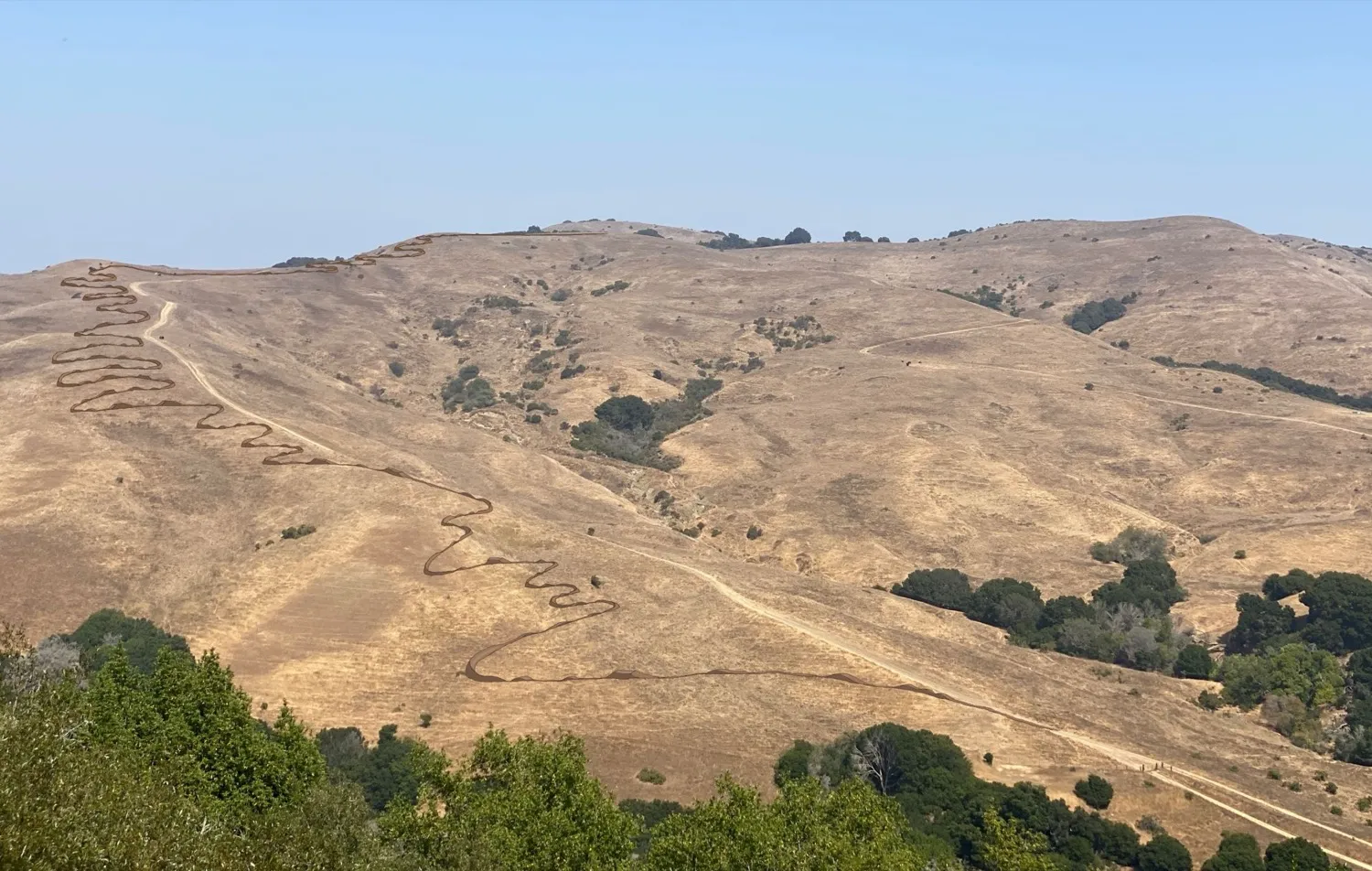
Conceptual rendering showing the trail on the hillside — a narrow ribbon of switchbacks on open grassland. Source: Pointe Strategies / EBRPD
Flow trails create safe, accessible outdoor recreation for the whole community. Here's what they bring:
- Families ride together. Parents and kids of all ages can share the same trail — something that's nearly impossible on steep fire roads or technical singletrack.
- Beginners have a place to start. Not everyone wants to learn to ride on a fire road with hikers, horses, and fast descending bikes. A dedicated flow trail gives new riders a controlled, predictable environment.
- Trail conflicts go down. Separating bikes from shared trails reduces the encounters that lead to friction between hikers, equestrians, and cyclists.
- Community builds around it. At Briones Regional Park, volunteer Dig Days to maintain the new bike trails fill up every time. Flow trails create stewardship, not just recreation.
- Kids get outside. A fun, approachable trail close to neighborhoods gives families a reason to spend time outdoors together.
- Access for underserved communities. The nearest flow trails all require a car trip. A trail at Wildcat puts this experience within reach of Richmond and El Cerrito families who can ride to the park from home.
More popular than most people realize, and the story started a few miles from Wildcat Canyon. In 1998, Berkeley High math teacher Matt Fritzinger started the first organized high school mountain bike team in California. In 2001 he organized the NorCal High School Cycling League, the first league of its kind anywhere. By 2009 that model had grown into the National Interscholastic Cycling Association (NICA), which today counts more than 24,500 student-athletes and 14,500 volunteer coaches across 33 leagues, with new leagues still joining.
The league that started it all now spans more than 100 Northern California high school teams, including the East Bay teams whose riders first proposed this trail (see the demand question). EBRPD's own surveys tell the same story locally: 17 to 24% of park users ride, and Tilden and Wildcat alone log about 40,000 riding hours a season (who uses the parks).
High school mountain biking was invented in the East Bay. A generation later, the kids carrying that tradition still have zero dedicated bike trails in Wildcat Canyon to learn on.
It puts them on a team with no bench. High school mountain biking runs on a model most school sports can't offer: no tryouts, no cuts, and everyone rides. Racing is optional, boys and girls train together, and a kid who has never done a sport before is as welcome as the one chasing a podium. That is the NICA model, and it is a big part of why the sport keeps growing.
What kids get out of it is what parents hope any sport delivers, plus a few things most can't: fitness in an activity they can keep for life, confidence built on visible progress (the feature you walked around last month is the one you ride today), and the steady judgment that comes from reading real terrain at a speed you chose.
And none of it stops at graduation. The same beginner-friendly trail that serves a sixth grader on Saturday morning serves their parents on the same ride, and the after-work rider on Tuesday. What's missing is a place close to home: the East Bay's school teams have around 400 riders, and the nearest purpose-built trail is a car trip away.
The bike is the hook. A teenager who would never volunteer for a five-mile hike will happily spend a Saturday covering twice that ground on two wheels, and every one of those hours is spent outdoors, in the hills, off a screen. For a lot of families, riding is the thing that finally makes the park compete with the couch.
It also turns young riders into stewards. Trail communities teach kids to care for what they ride through volunteer dig days, and NICA runs a national program built on exactly that: through Teen Trail Corps, student-athletes contributed more than 61,000 hours of trail stewardship and community service in 2024 alone. Locally, the Bicycle Trails Council of the East Bay and the school teams have committed in writing to help build and maintain this trail.
For Richmond and El Cerrito, Wildcat Canyon is the nature next door: free, and reachable without a car. A trail a kid can ride to from home makes the park part of growing up here. Kids who grow up in a park become the adults who look after it.
More than most sports, because it runs on volunteers. Trails get built and cared for by the people who ride them. That is not a promise, it is the sport's standard practice, and here it is already in writing: the Bicycle Trails Council of the East Bay and the local school teams have committed to help build and maintain this trail.
EBRPD's own Briones pilot shows what that looks like in practice: volunteer dig days filled up every time, bootleg trail building stopped, and the Board made the program permanent. Separated trails also calm the shared trails for hikers and equestrians, which is part of why one in five petition supporters identify as hikers, walkers, or runners.
And a free trail next to Richmond and El Cerrito is community infrastructure in the plainest sense: a healthy place for kids after school, for adults after work, and for families on weekends, in a park they can reach without a car.
Yes, and that's one of the strongest reasons to build it here. The trail would be free to use, on public land, and reachable by bike from home for the neighborhoods next to the park: Richmond, San Pablo, El Cerrito, and the surrounding communities. No car, no entry fee, no membership.
Compare that to the status quo. The nearest comparable flow trails all require a car trip, which puts them out of reach for many local families. Today, access to this kind of riding depends on whether your family can drive to Marin or Santa Cruz on a weekend. A trail at Wildcat removes that barrier: kids can pedal there after school.
That's why Rich City Rides, Richmond's community cycling organization focused on bike access and equity, supports the project, alongside the local school mountain bike teams from Richmond, El Cerrito, Berkeley, and Albany whose riders first proposed it.
Mountain biking doesn't require an expensive bike. The trail is rated green/blue and designed to be ridden on any working bike a kid already owns. Building safe, free places to ride close to where people live is how the sport gets more accessible, not less.
Yes, and one of the clearest is easy to overlook: a local trail cuts driving. The greenest thing a mountain-bike community can have is a trail it can ride to, because the real environmental cost today is the driving.
Today, not a single purpose-built bike trail is within biking distance of a kid in Richmond or El Cerrito. The nearest real flow trails all require a car: the closest is about a half-hour drive each way, and the good ones are an hour or two. So every ride at a real trail is a car trip.
The local high school mountain bike teams alone have around 400 riders. If those families drive to reach a rideable trail even one or two times a week, then even by a conservative estimate (counting only the nearest trail, and assuming families carpool) that adds up to tens of thousands of gallons of gasoline and dozens of tons of CO2 burned every year, just to go ride. Aim for the better trails farther away and the number climbs several times higher.
A flow trail in Wildcat Canyon flips that. It would be the first bike trail a local kid could ride to from home, or reach with a short drive instead of a long one. Building here doesn't add to the environmental cost. It's how you cut the one that's already being paid, every week, in traffic and tailpipe emissions.
Yes. Federal accessibility standards for trails are set by the U.S. Access Board's Outdoor Developed Areas guidelines, and they distinguish between trail types: the technical requirements (surface, grade, width) apply to trails designed for pedestrian use. Trails designed for bicycling or horseback riding are a different facility type and are not subject to the pedestrian-trail standards, the same way a BMX track or an equestrian arena isn't required to be built like a sidewalk.
So nothing is being "gotten around." EBRPD builds and manages accessible facilities across the district and applies accessibility law to every project through its normal review, which the EIR process includes.
It's also worth knowing that a purpose-built bike trail expands access for riders with disabilities. Adaptive mountain bikes (aMTBs) and pedal-assist bikes let people ride trails they couldn't otherwise, and the Bay Area is home to BORP in Berkeley, one of the largest adaptive cycling programs in the country. A gentle-grade, speed-controlled flow trail with rollable features is among the most adaptive-friendly trail types there is.
The trail is rated green/blue (beginner to intermediate) — the easiest difficulty ratings. It's designed so a 5-year-old on a 20" bike and an experienced adult can both enjoy it.
- All features are rollable — wheels never need to leave the ground. Every jump has a ride-around option. (EBRPD project page)
- Speed is controlled by design. Berms, rollers, and curves naturally manage momentum. Unlike fire roads where gravity just accelerates you downhill, the trail's shape keeps speeds in check.
- Average grade of 5-8%. For comparison, a typical wheelchair ramp is about 8%. This is not steep. (source)
- Turnout areas let faster riders pass safely, so beginners never feel pressured.
- Progressive features — gentle at the start, building gradually. Riders choose their own comfort level.
- Bail-out points. The trail crosses the adjacent Mezue fire road as it descends, so riders can exit partway down and ride the road back up. You don't have to commit to the whole trail — families can ride just the easier upper section if that's what works for them.
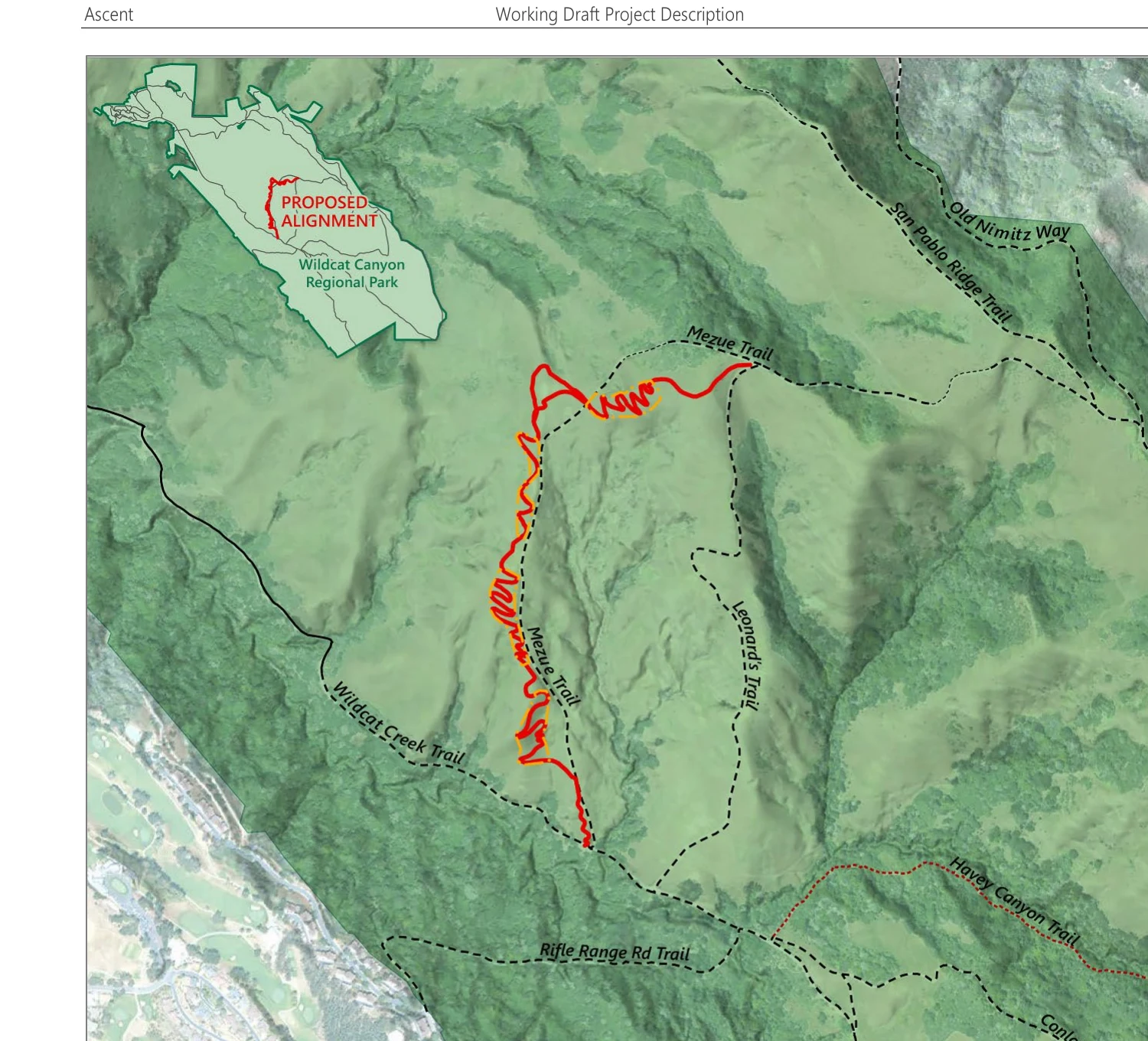
Proposed trail alignment (red) showing the trail crossing Mezue fire road as it descends — each crossing is a natural bail-out point. Source: EBRPD Working Draft Project Description, Figure 2-2
The design philosophy is simple: make the trail fun for everyone, not just experts. The most experienced rider and the newest beginner should both have a good time.
Some photos circulating online show large ramps, drops, and prefabricated features taken from a design catalog. Those are not what's being built. They are examples of features that exist at other trails nationally, included in a design study for reference — not the approved plan for Wildcat.
Here is what EBRPD actually says in their project FAQ:
"All trail features would be rollable, meaning able to be ridden without requiring cyclists' wheels to leave the ground. The trail would be appropriate for beginner and intermediate riders. These features and the ability to navigate them requires riders to moderate speed. The average grade of the flow trail would not exceed 5-8%."
"Rollable" means every feature can be ridden with wheels on the ground — no one has to go airborne. The trail is rated green/blue (beginner to intermediate), not advanced or expert. A 5-year-old on a 20" bike should be able to ride it.
EBRPD has not finalized the design. The final features will be determined through the environmental review process, not from a design catalog.
This concern circulates online, so it is worth looking at what the safety data actually shows.
E-bike battery fires are real, and they happen almost entirely indoors. The federal Consumer Product Safety Commission documented 227 e-bike fire incidents nationwide from 2019 to 2023, against millions of e-bikes in use. The epicenter is New York City, where the fire department has tracked over 700 lithium battery fires since 2019, concentrated in uncertified, aftermarket delivery-fleet batteries charged and stored inside apartments. When New York required UL-certified batteries, deaths fell 67 percent in a single year. The problem is cheap uncertified batteries indoors, not e-bikes as a category. (CPSC safety data, UL Standards report)
We could find no documented case, anywhere, of a bicycle crash puncturing a battery and starting a fire, on a trail or otherwise. Lift-served bike parks like Northstar and Whistler have hosted e-mountain-bikes through more than a decade of hard crashes and dry mountain summers. The real-world record from all of that riding: zero fires.
Same scale throughout. Sources: NFPA, CPSC.
For scale: U.S. fire departments respond to about 215,000 vehicle fires every year, overwhelmingly gasoline cars — the same cars parked at every trailhead in every park today. Per vehicle, studies find EVs catch fire at a small fraction of the rate of gas cars. And the phones in every visitor's pocket carry the same lithium battery chemistry. Nobody proposes banning cars from parking lots or phones from parks; singling out bicycles with the smallest batteries of all is not a safety argument. (NFPA vehicle fire data)
Two local facts complete the picture. Class 1 e-bikes have been allowed on every bike-legal trail and fire road in the East Bay Regional Park District since 2023, including the fire roads of Wildcat Canyon today, so the proposed trail would not introduce batteries to the park in any way. And wildfire risk is analyzed in the full Environmental Impact Report now underway, which is the rigorous review this project chose. (EBRPD project page)
No. A bulldozer is road-building equipment, and this is not a road. The project is still in environmental review and the design is not finalized. The details below come from EBRPD's current draft project description.
As currently proposed, the 1.44-mile trail (just 36 to 48 inches wide) would be built with small, specialized trail-building equipment: a mini-excavator and a compact trail dozer, along with hand tools, stone work, and carpentry for features like bermed turns.
For perspective, the park's existing fire roads are maintained with full-size road graders. This trail would be built and maintained with far smaller equipment than the roads already crossing the park.
What the draft describes:
- Cut-and-fill is balanced on site, so dirt is shaped in place, not hauled in or out.
- Most rock is sourced on-site to match the natural setting, with some boulders brought in for durable features.
- Construction is designed to minimize disturbance, and ground disturbed outside the trail is replanted and restored.
- Biologists are on site to flag and route around sensitive plants and wildlife. The review includes ten biological protection measures.
- Local bike clubs and volunteers help build and maintain the trail, often by hand on community trail days.
Final construction methods will be set through the public environmental review process. The current draft points to small equipment and hand work, not heavy road construction.
Source: EBRPD Draft Wildcat Flow Trail Project Description, Section 2.4.4 (Construction). A draft document; the project is still under environmental review.
No. It runs alongside a road that is already there, and ends at another one.
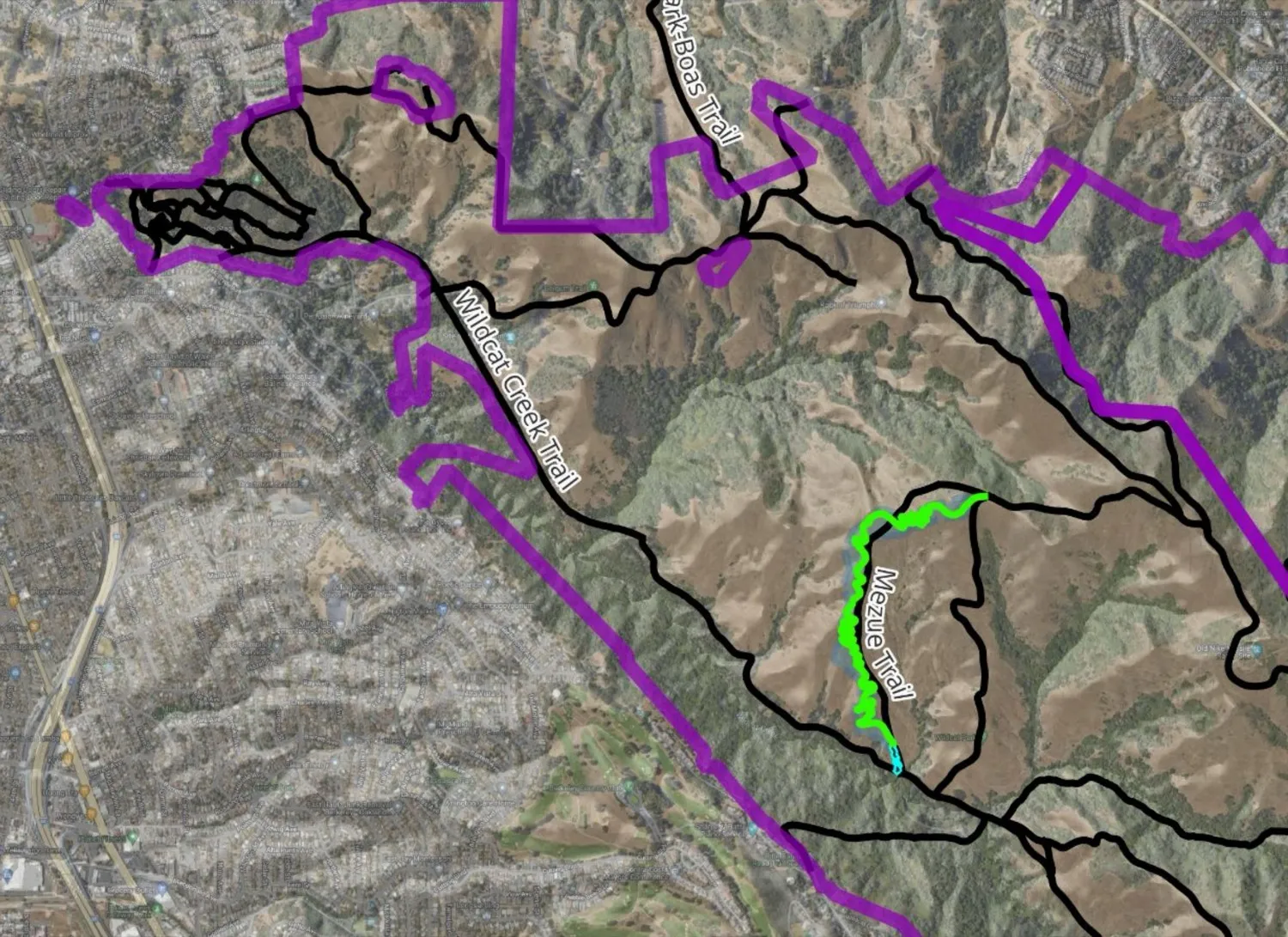
Green is the proposed trail. Black is what already crosses the park. The trail follows the existing Mezue Trail down the hillside and finishes where it meets the Wildcat Creek Trail, which is how EBRPD describes it in the project description:
"The final portion of the proposed trail would run parallel to the Mezue Trail until intersecting with the Wildcat Creek Trail."
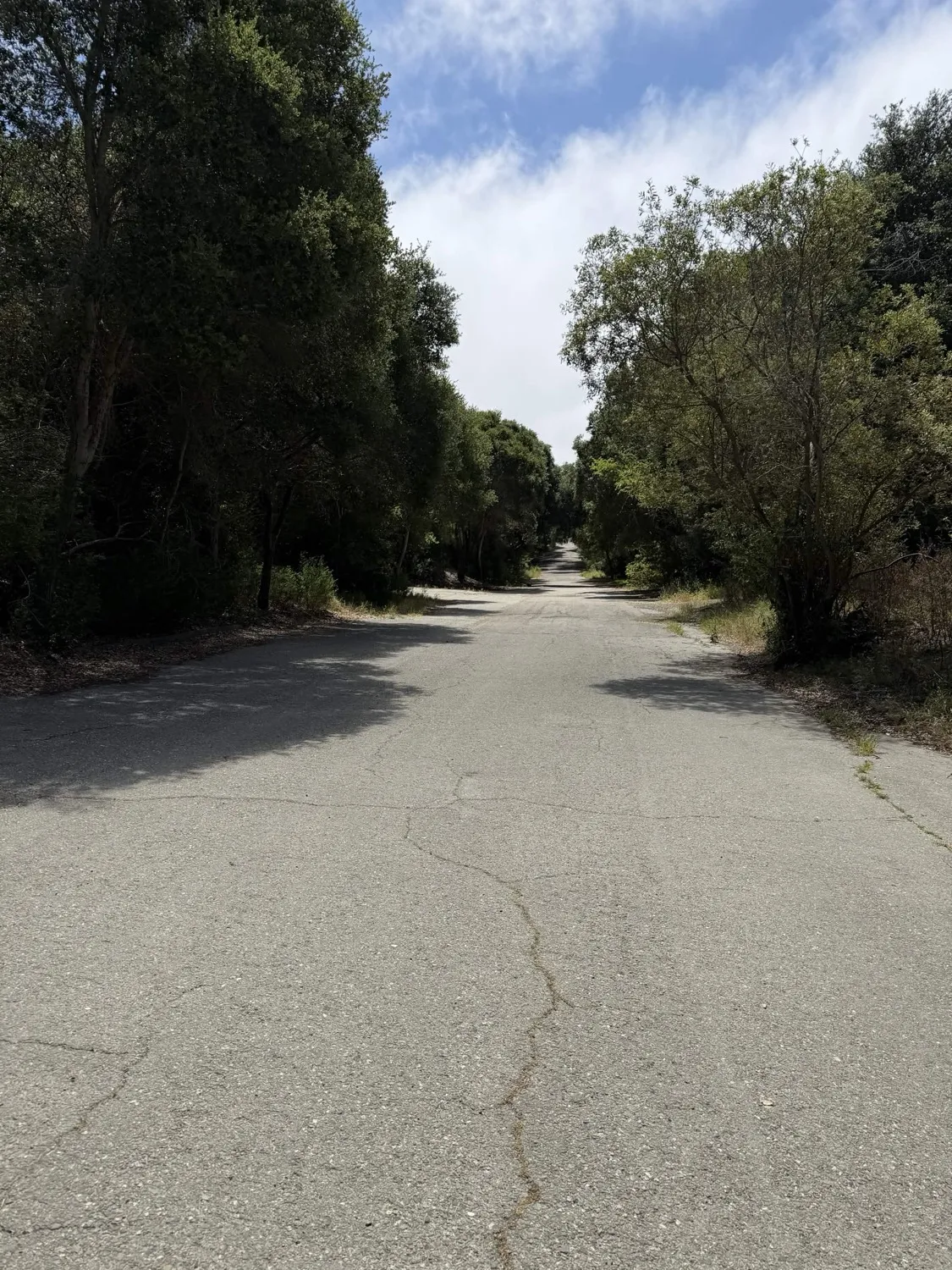
Then there is the question of size. EBRPD puts the trail at 36 to 48 inches wide. Here is the Wildcat Creek Trail it ends at, part paved and part gravel, wide enough to drive a vehicle on:
Here is the same thing on EBRPD’s own project map. The thick red lines are the service roads that already cross the park. The thin line marked “Trail” is the proposal.
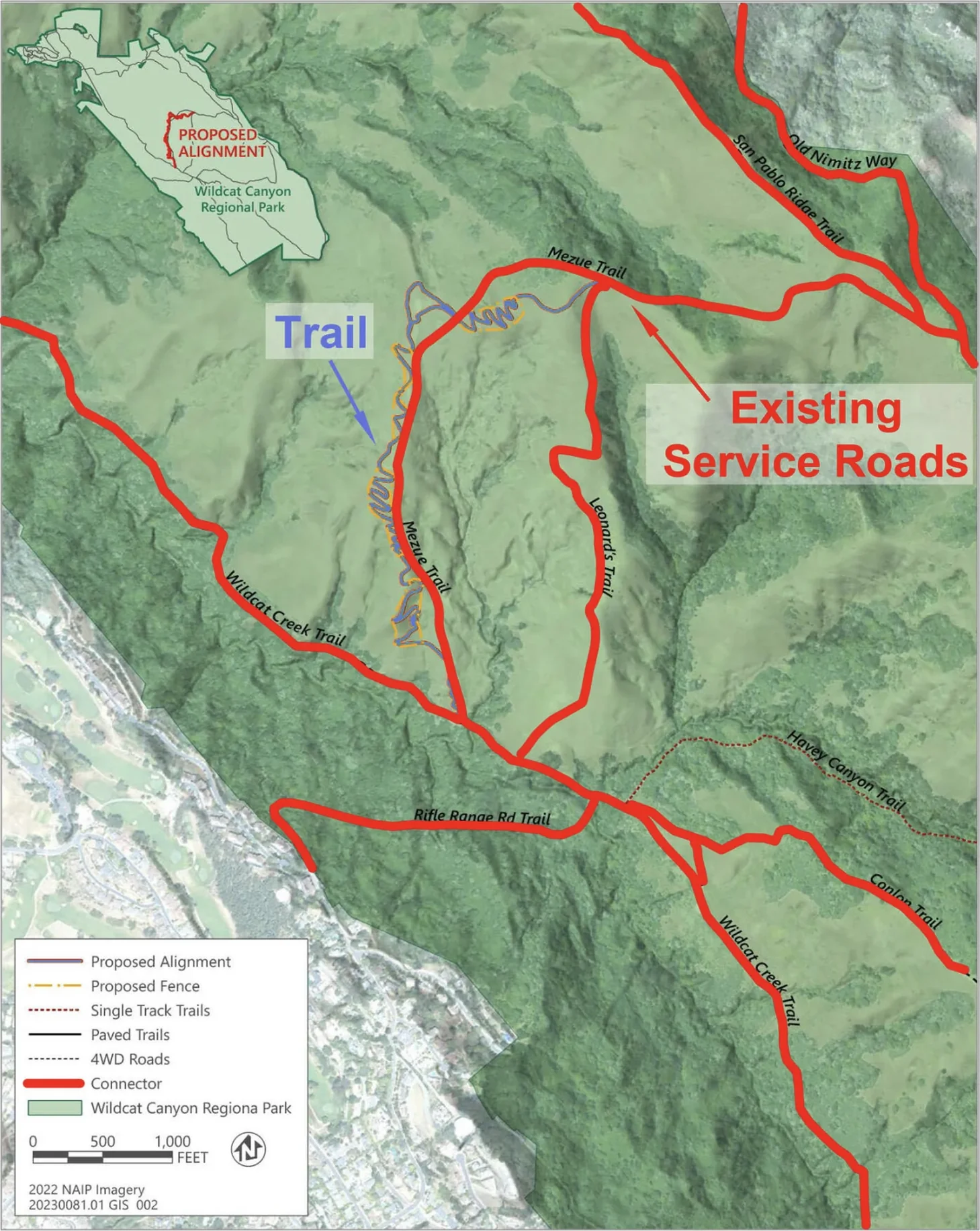
Map from Figure 2-2 of EBRPD’s Wildcat Canyon Regional Park Bike Trail Working Draft Project Description, prepared by Ascent Environmental. Line colours and weights have been adjusted, and labels added, to show the size of the proposed trail relative to the existing service roads.
A path a yard wide, laid beside a road you could drive a truck up, does not divide anything. And the project subtracts a bike route rather than adding one: as part of it, Leonard’s Trail closes to bikes and becomes hiker and equestrian only.
More on exactly where it goes and on what is already open to bikes.
The proposed trail is located in Wildcat Canyon Regional Park, a 2,789-acre park in Contra Costa County managed by the East Bay Regional Park District (EBRPD). The park is connected to Tilden Regional Park and sits in the hills above Richmond and El Cerrito.
The specific alignment was designed by Pointe Strategies and follows a corridor in the western portion of the park, north of Wildcat Creek Trail near Mezue Road — covering approximately 1.4 miles with approximately 500 feet of elevation change.
To put the scale in perspective: Wildcat Canyon (2,789 acres) and neighboring Tilden Regional Park (2,079 acres) together cover nearly 5,000 acres of connected parkland. The project corridor is about 18 acres, roughly 0.4% of that combined parkland (and about 0.6% of Wildcat Canyon alone). The trail itself is far smaller: a 1.4-mile path about 4 feet wide, under one acre of actual ground.
The proposed flow trail (green) within Wildcat Canyon Regional Park, alongside the existing Mezue and Wildcat Creek trails. (See what the corridor looks like today →)
All of the maps are collected under Is there a map of the trail?
Yes, several. Start with the closest view and work outward.
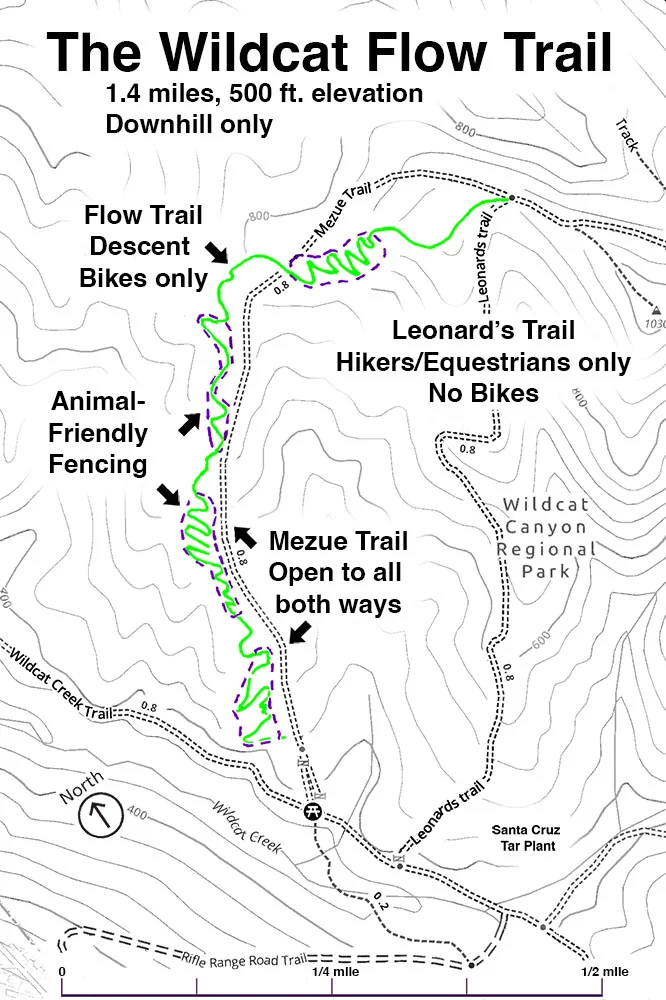
The flow trail (green) beside the Mezue Trail: about 1.4 miles and 500 feet of elevation, ridden downhill only. Purple marks the wildlife-friendly fencing. As part of the project Leonard’s Trail becomes hikers and equestrians only, while the Mezue Trail stays open to everyone in both directions. Map by Michael Mejia, Bicycle Trail Council of the East Bay. (Open full size →)
The corridor from the air: the proposed trail (green) inside the park boundary, beside the Richmond and El Cerrito neighborhoods. (See what the corridor looks like today →)
EBRPD’s own project map. The thick red lines are the service roads that already cross the park; the thin line marked “Trail” is the proposal. From Figure 2-2 of EBRPD’s Wildcat Canyon Regional Park Bike Trail Working Draft Project Description, prepared by Ascent Environmental. Line colours and weights adjusted, labels added.
For the whole park, the project page has EBRPD’s official park map and an interactive map you can zoom. More on exactly where the trail goes.
This is the most common objection — "we're not anti-bike, just anti-this-location." But no alternative location is ever named. That's because the requirements are specific:
- Accessible from school: NICA teams from Berkeley, El Cerrito, Albany, and Richmond need a trail they can ride to after school before dark — not a 30-minute drive away
- Already open to bikes: The proposed trail runs directly alongside the Mezue fire road, where bikes already ride today. This isn't introducing cycling to a new area
- Minimal environmental impact: EBRPD staff conducted site assessments and identified this corridor specifically because it avoids or minimizes impacts to sensitive habitats
- Already disturbed: The site is actively grazed cattle land with existing roads, fencing, and ranching infrastructure
- Limited options: Only two parks in west Contra Costa allow mountain biking at all (Wildcat Canyon and Crockett Hills) — both multi-use only. The nearest bike-only trails are at Briones, over 30 minutes away by car.
There's also an equity dimension. The nearest flow trails all require a car trip, and none are within biking distance. Many Richmond and El Cerrito families don't have easy access to those facilities. Building at Wildcat puts a beginner-friendly trail within biking distance of neighborhoods that have historically been underserved by outdoor recreation infrastructure.
In fact, the trail was originally proposed near Leonard's Trail in 2020. EBRPD staff moved it to the Mezue corridor specifically to avoid environmentally sensitive species — demonstrating that the district takes the biology seriously. Staff also evaluated three alternative sites proposed by opponents and found that all three had greater environmental or user impacts than the current location.
The EIR will analyze alternative sites as required by CEQA. But "somewhere else" without naming a specific location that meets these criteria isn't an alternative — it's a way to say no without saying no. (Read EBRPD's full project rationale →)
The Park District's mission is explicitly both. EBRPD's mission is to preserve a rich heritage of natural and cultural resources and to provide "open space, parks, trails, safe and healthful recreation and environmental education." Trails and recreation aren't an exception to the mission — they're written into it, right alongside preservation.
That balance runs through the District's own planning, too. Bicycling has been a recognized use in Natural Units since the 1997 Master Plan, and the 2013 Master Plan opened narrow natural-surface trails to bikes for the first time. Even the 1985 Wildcat Canyon Land Use Plan — the document opponents most often quote — lists park facilities "for hikers, joggers, equestrians, motorists, and bicyclists."
A professionally designed, sustainable flow trail serves the recreation half of the mission while protecting the resources the other half preserves. It's a both/and, not an either/or — exactly the balance the Park District was created to strike. (Read EBRPD's mission statement →)
No. This is a common mix-up between two different agencies. Wildcat Canyon Regional Park is a recreation park owned and run by the East Bay Regional Park District (EBRPD), the public agency that owns and manages the park the trail would sit in. It is not a protected drinking-water watershed.
The protected drinking-water watersheds in our area belong to a different agency, the East Bay Municipal Utility District (EBMUD): the restricted, permit-only lands around its reservoirs such as San Pablo and Briones. Wildcat Canyon is not one of those.
Wildcat Creek did serve as a local drinking-water source about a century ago, but that ended generations ago. The creek's old reservoir (Jewel Lake, upstream in what is now Tilden) was turned over to recreational use back in 1933, once EBMUD brought in Mokelumne River water, and Wildcat Creek has not been a drinking-water supply since.
To be precise, the park does sit within the Wildcat Creek watershed in the ordinary sense that all land drains somewhere, and the creek and its habitat are real and worth protecting. That protection is exactly what the Environmental Impact Report addresses, through water-quality, erosion, and biological review. It is just not a closed drinking-water watershed where recreation is off-limits. In fact, even EBMUD's own protected watershed has opened some of its trails to bikes (the Pinole Valley and Eagle's Nest trails, with a permit).
That's exactly what the Environmental Impact Report (EIR) is designed to determine. The project is going through the full California Environmental Quality Act (CEQA) review — the most rigorous environmental review process in the state.
The EIR will study potential impacts on biological resources, water quality, soil erosion, wildlife, cultural resources, and more. If significant impacts are identified, the project must either mitigate those impacts or the Board can choose not to proceed.
It's also worth understanding the actual site: the proposed trail corridor runs alongside the existing Mezue service road — a fire road that already allows vehicle and bicycle traffic. The area is actively grazed by cattle under a park district lease. This isn't a pristine wilderness being opened up for the first time — the park has a history of human use including a Cold War-era Nike missile installation, the Belgum Sanitarium, and ongoing cattle ranching. It's a working landscape with roads, fencing, and existing bike use. The cattle themselves cause significant ground disturbance, soil compaction, and erosion across the hillside — far more impact than a 4-foot-wide hardened trail. That said, we support a thorough CEQA review to assess and address any impacts. (See photos of the site today)
On bikes versus hikers specifically, the peer-reviewed research finds the impacts similar and the design decisive: see what the science says.
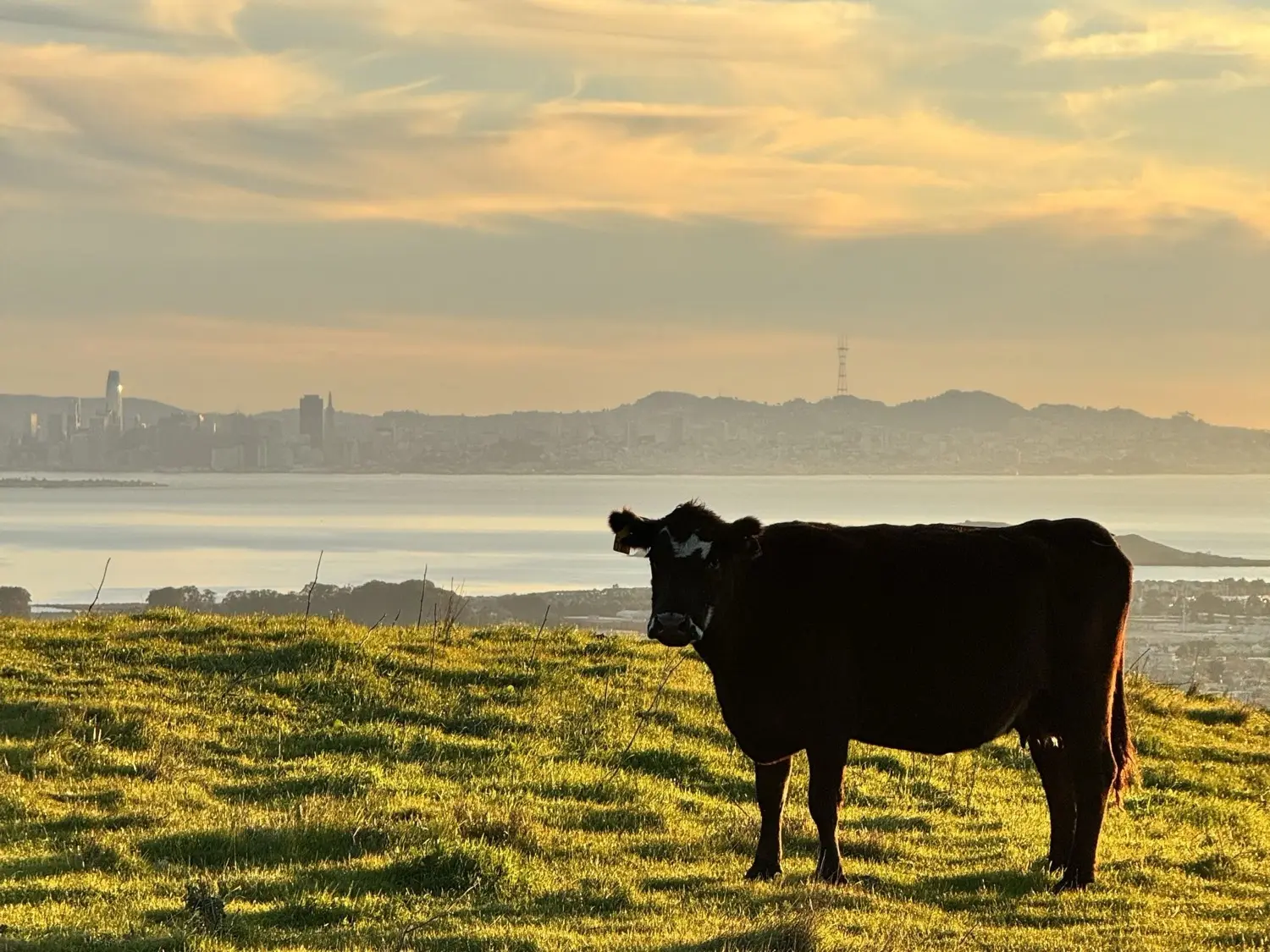
The trail corridor at golden hour: grazed cattle land above Richmond and the Bay, not pristine wilderness.
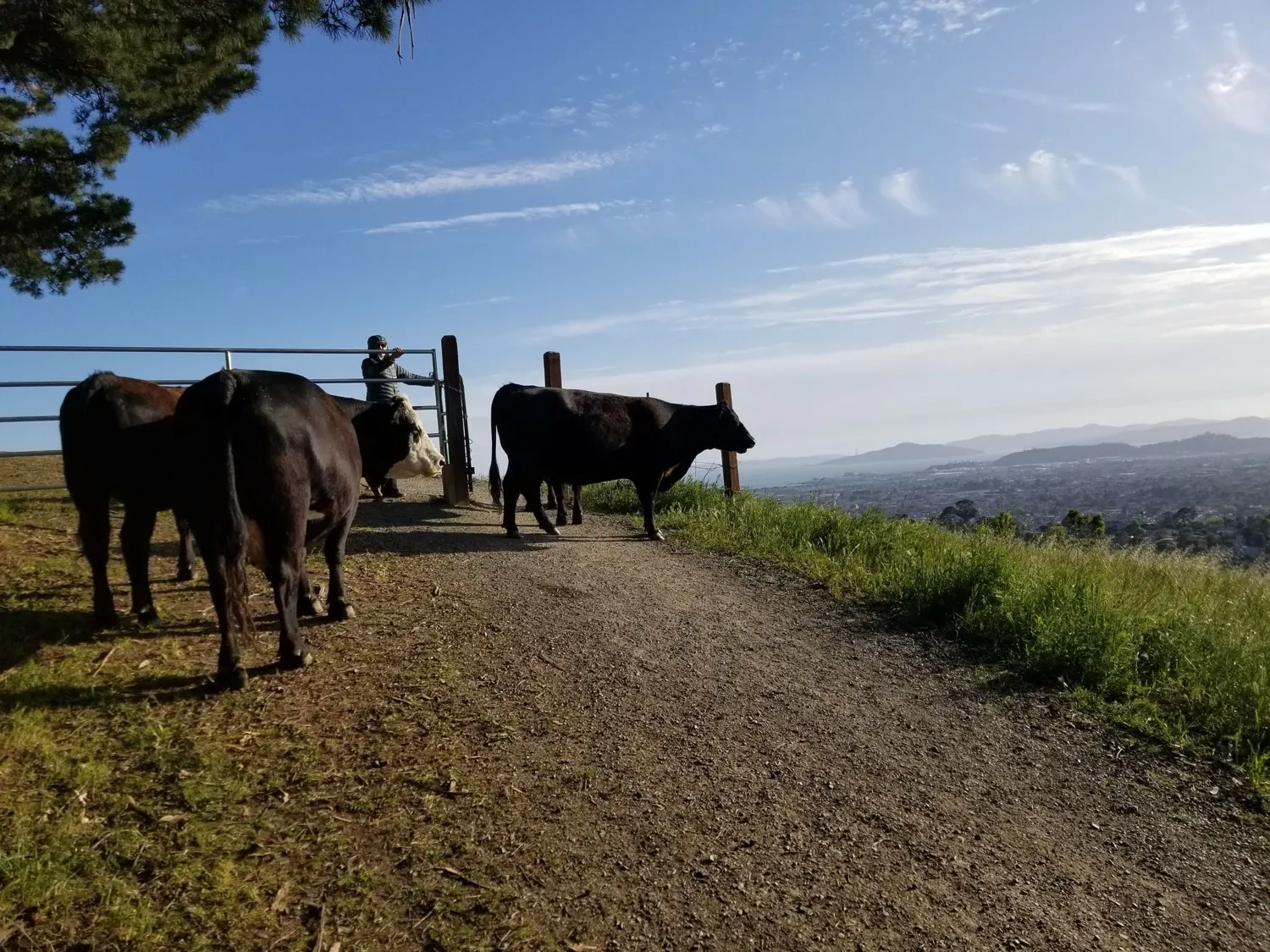
Cattle at Wildcat Canyon near the proposed trail site — an active working landscape, not pristine wilderness.
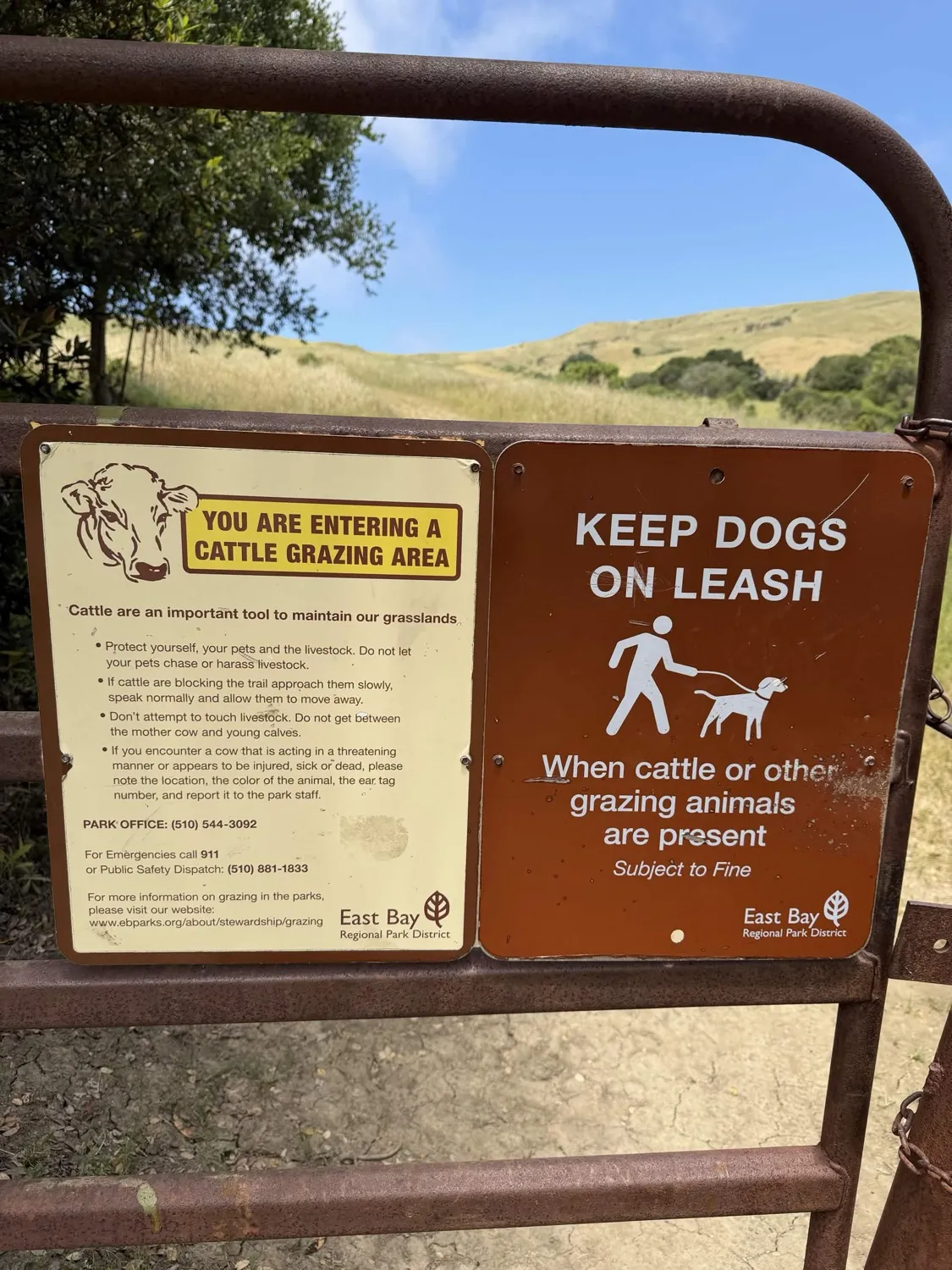
EBRPD's own signage at the trail corridor entrance.
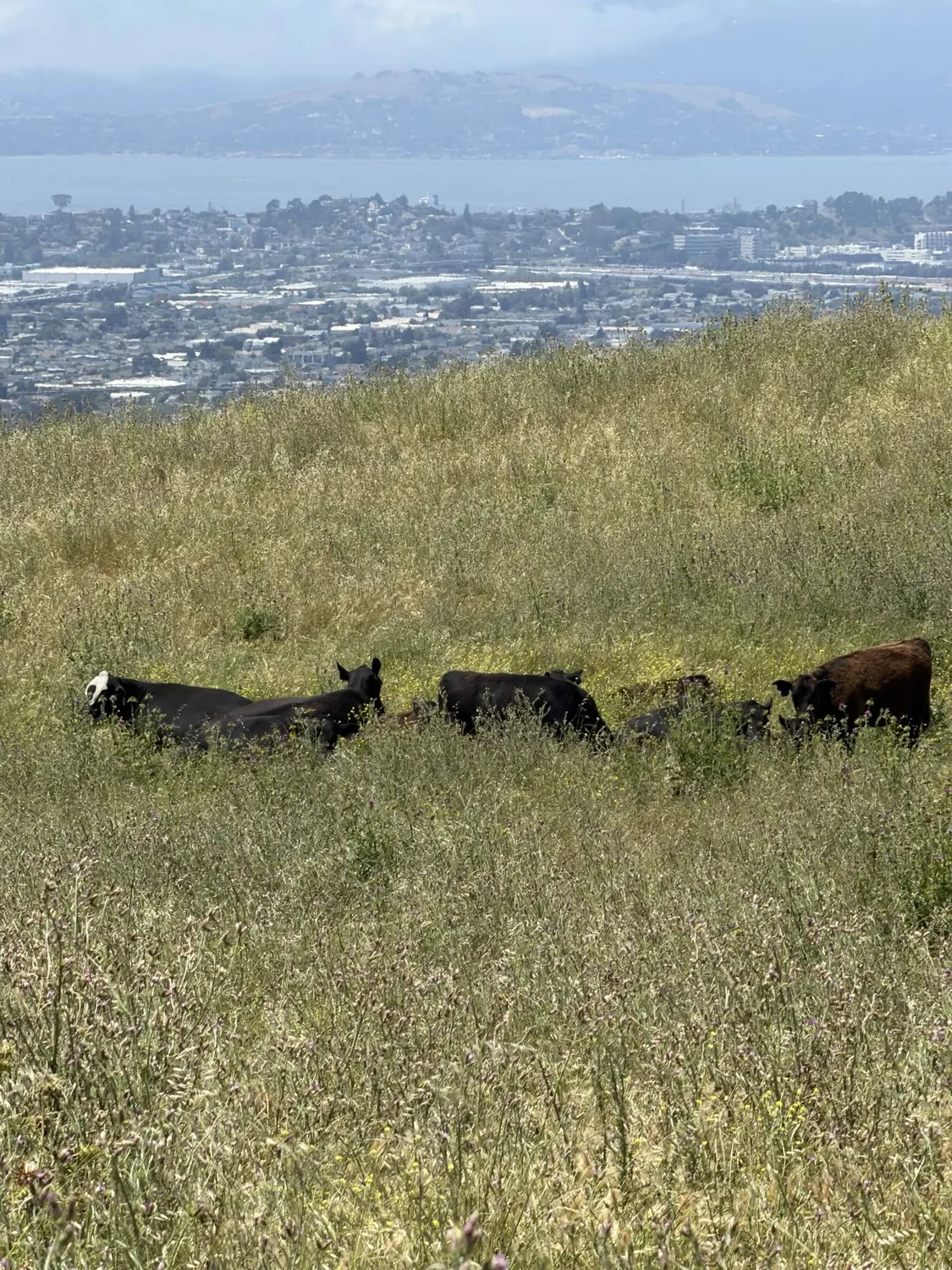
The trail corridor today: cattle grazing with Bay and city views.
EBRPD commissioned a Biological Resources Assessment from Nomad Ecology, a professional ecological consulting firm that conducted field surveys in both 2022 and 2024. Their key findings:
- No special status plant species were detected in the study area — zero, across two years of surveys
- Every impact category was assessed as "less than significant" with standard mitigation measures
- No new barriers to wildlife movement at the landscape scale — fencing will be wildlife-friendly (permeable, smooth, not barbed) with gaps between sections for animal passage
- The trail will not be used at night, when most wildlife is active, meaning no added disturbance during peak movement hours
- 10 specific mitigation measures identified, including pre-construction wildlife surveys, biological monitoring, nesting bird protections, and erosion controls
This is not speculation — it's the conclusion of qualified biologists with degrees in biological sciences who walked the site. (Read the full 186-page Biological Resources Assessment →)
Professionally designed flow trails are built to reduce environmental impact compared to informal, unsanctioned trails. The design manages water drainage, prevents erosion, and concentrates use in a defined corridor rather than allowing it to spread through the landscape.
Local precedent: EBRPD's own Briones Pilot Project (2023–2024) demonstrated this firsthand — when dedicated bike trails were formalized, 5 miles of unsustainable bootleg trails were closed and restored, and 1.28 miles of new pedestrian-only trails were added. The environment got better, not worse. See the full Briones case study →
Not according to the peer-reviewed research. The standard scientific comparison, a review of recreation-ecology studies from the United States and Australia published in the Journal of Environmental Management (Pickering, Hill, Newsome and Leung, 2010), found that "many impacts on vegetation, soils and trails are similar for the three activities" of hiking, mountain biking and horse riding, "although there can be differences in severity." The list of impacts is the same for everyone: compaction, widening, exposed roots and rocks, and erosion wherever water runs down a trail.
The two bike-specific problems the review names are skidding and unauthorized trails, jumps and features. Both are exactly what a designed, sanctioned trail is built to remove: grade reversals and drainage so water leaves the tread instead of running down it, berms and rollers that manage speed without hard braking, and a legal place to ride that takes the pressure off informal trails (see the Briones example: 5 miles of illegal trails closed and restored).
Later field studies point the same way. A two-site study in Norway (Evju and colleagues, same journal, 2021) found that on-trail use by hikers and mountain bikers had relatively limited effects on trail widening and deepening overall; the wear showed up on wet ground, and there a higher share of bikes made it worse, which is an argument for drainage, not against bikes. A 2024 study of bike trails in an urban national park (Smith and Pickering, Environmental Management) measured real soil and vegetation loss and found that formal trails were less eroded than informal ones, and that "trail grade, slope and alignment" were the best predictors of a trail's condition. In other words, impacts are real for every kind of user, and design is what controls them. The science review written for land managers by USGS scientist Jeff Marion and Virginia Tech's Jeremy Wimpey (2007) reaches the same conclusion.
That is why the trail's design (5 to 8% average grades, drainage before and after every berm, a defined corridor) matters more than who is on it, and why soil erosion and water quality are core topics of the Environmental Impact Report.
Sources: Pickering et al., 2010 · Evju et al., 2021 · Smith and Pickering, 2024 · Marion and Wimpey, 2007 (USGS)
EBRPD's professional Biological Resources Assessment (conducted by Nomad Ecology, 2022–2024) specifically evaluated wildlife impacts. The conclusion: all wildlife impacts would be less than significant with standard mitigation measures.
Key findings on wildlife:
- Wildlife corridors preserved: The project will not introduce any new barriers to wildlife movement at the landscape scale. The study area is already constrained by dense urban development to the north and west.
- Wildlife-friendly fencing: Only discrete sections of the trail will be fenced, with unfenced gaps between them. Fencing will be permeable, smooth (not barbed), allowing wildlife to pass through freely.
- Mountain lion: The study area is not considered high-quality mountain lion habitat. Any mountain lions in the area would be active at night after the park closes and the trail is not in use.
- Nesting birds: Construction will be timed to avoid breeding season, or pre-construction surveys with protective buffers will be conducted around any active nests.
- 14 special status wildlife species were evaluated. For each one, impacts were assessed as less than significant with the 10 mitigation measures identified in the report.
The trail is being built adjacent to the existing Mezue Trail — an area already subject to human activity including hiking, cycling, and cattle grazing. This is not new disturbance in an undisturbed area. (Read the full Biological Resources Assessment →)
That is the assessment's own conclusion, in Section 5.1.5, Wildlife Habitat and Movement Corridors (Updated January 2026, page 70):
"The project’s location immediately adjacent to the existing Mezue Trail will keep the human disturbance associated with the new trail within an area that is already routinely disturbed in its existing condition. The new trail will not introduce any lighting and will not be used at night, when many wildlife species would be expected to be actively moving through the landscape. As a result, no significant impacts to wildlife movement are anticipated."
The creek's protection is built into the review. A few facts help here:
- The trail does not touch the creek. Wildcat Creek runs roughly 230 feet from the study corridor at its closest point, and the trail's lower end connects to the Wildcat Creek Trail (the existing hiking path), not to the creek itself.
- The creek was still studied. The Biological Resources Assessment evaluated the creek and its riparian corridor as adjacent habitat, including breeding potential for California red-legged frog and western pond turtle and nesting habitat for riparian birds, and concluded the trail would not create a barrier to wildlife movement.
- Hydrology gets its own review. Runoff, drainage, erosion, and water quality are core EIR topics (see what the EIR studies), and the trail design manages drainage with rollers and grade reversals specifically to prevent sediment from moving downslope.
Some comments have pointed to a Wildcat Creek restoration effort as a reason to oppose the trail. That restoration project is a separate EBRPD project in Tilden, on a different stretch of the creek more than two miles upstream of the trail site. Both projects can and should succeed; they don't conflict.
As for the idea that this "impacts the whole park": the project is a 1.4-mile trail alongside the Mezue fire road, in a corridor that is well under 1% of the park. Riders reach it on routes that are already open to bikes today, so it opens no new areas of the park to riding, and the EIR's required cumulative-impacts analysis will examine exactly this question.
Yes. Both the Wildcat Canyon Land Use Plan (1985) and the EBRPD Master Plan (2013) explicitly support this project. The 1985 Land Use Plan is particularly significant because it recognizes bike riding as an established use in Wildcat Canyon — predating the organized opposition by decades.
EBRPD's own FAQ states it directly:
"The proposed Wildcat Bike Trail is consistent with the Wildcat Canyon Land Use Plan. The Land Use Plan states that bicycling, among other uses, is an appropriate use in Wildcat Canyon. The proposed trail would be developed in an existing opened area of Wildcat Canyon where bicycling is already an established use."
No amendment is needed — the plan already allows it. The 1985 Land Use Plan established bicycling as an appropriate and recognized use in Wildcat Canyon over 40 years ago. This isn't a recent policy decision — it's longstanding park practice with decades of documented history.
The proposed flow trail runs directly alongside the Mezue fire road, where bikes already ride today. This isn't introducing cycling to a new area — it's adding a purpose-built trail right next to an existing bike route.
See it on the District's own map. On EBRPD's current official Wildcat Canyon map (Rev. 2024/12), the legend marks paved and unpaved trails alike as "Hiker, Biker, Horse." Follow the dashed blue lines: San Pablo Ridge, Mezue, Leonard's, Conlon, Havey Canyon, Belgum, and the Wildcat Creek Trail are all open to bikes today. The only bike restriction on the whole map is seasonal: Havey Canyon closes to bikes and horses December 1 to March 1.
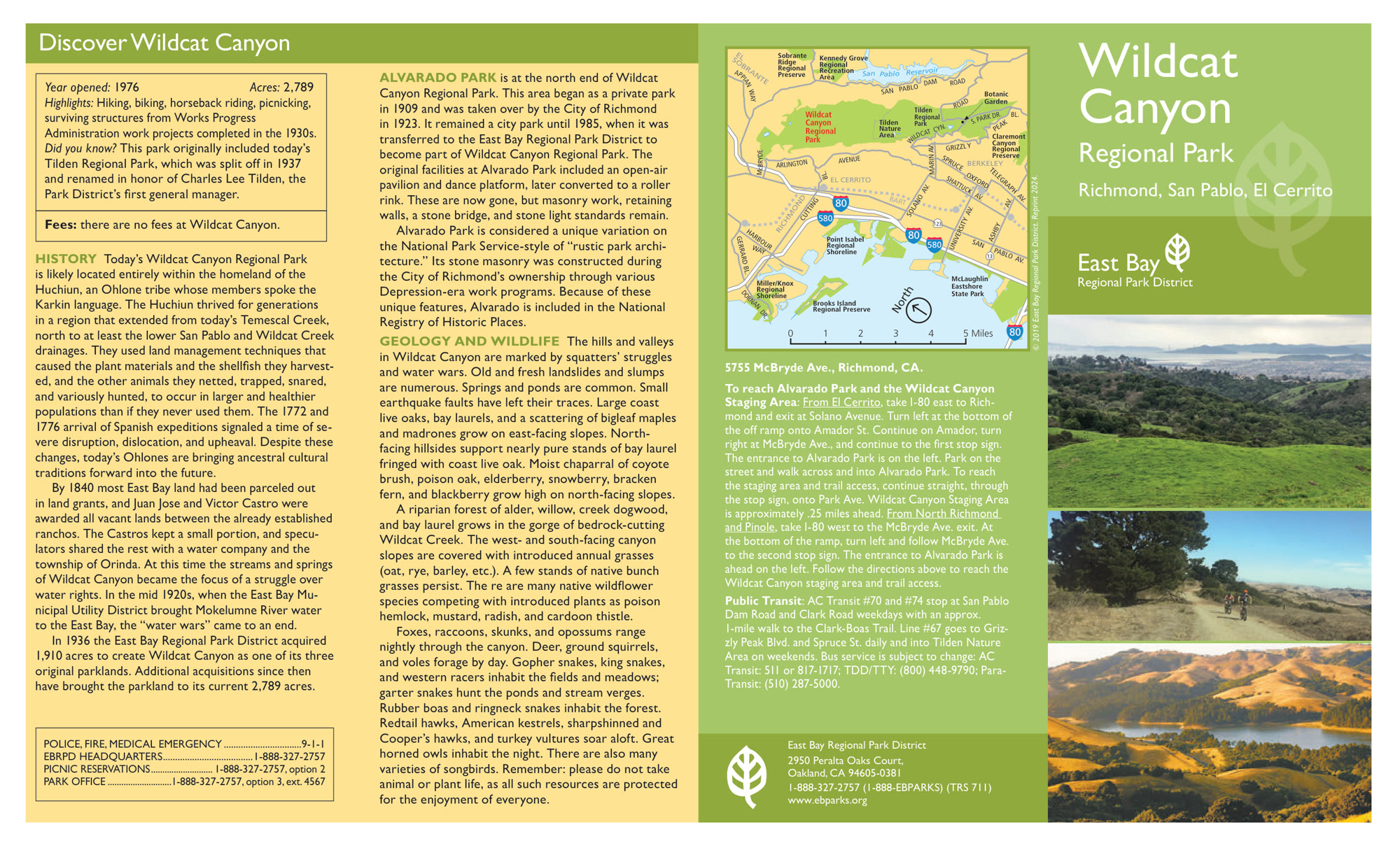
EBRPD's official park map. Tap to open the District's own brochure PDF at ebparks.org.
The main Wildcat Creek Trail — a wide paved road with existing heavy infrastructure. The proposed flow trail would be a 4-foot-wide dirt path. See more photos →
The 2013 Master Plan — the most current plan, superseding all prior versions — defines Natural Units as areas where:
"The primary planning and management objective of a Natural Unit is to preserve and enhance natural habitat. Natural Units constitute the vast majority of the parklands in which lower intensity recreational activities (like hiking, backpack and horseback camping, riding, bicycling, plant and wildlife study, educational pursuits and contemplation) are to be found."
— EBRPD Master Plan 2013, Section a. Natural Units
The 2013 Master Plan goes further, specifically calling for the Park District to:
- "Provide a diverse system of non-motorized trails to accommodate a variety of recreational users including hikers, joggers, people with dogs, bicyclists and equestrians"
- "Continue to add narrow trails designated as both single- and multi-use for hikers, equestrians, dog walkers, and bike riders throughout the system"
This project doesn't violate the plans — it follows them. For comparison, most of Briones, 97% of Pleasanton Ridge, and Crockett Hills are all designated as Natural Units and all contain trails that allow cyclists. This is standard practice across EBRPD. (Source: EBRPD FAQ)
Yes — and the numbers come directly from EBRPD, not from advocates.
According to the EBRPD project page:
- 40,000 riding hours per season are being logged on the same 30 miles of shared multi-use trails in Wildcat Canyon and Tilden
- Bikes are only permitted on approximately 1.5 miles of singletrack in these parks
- The existing trail system is "not adequately accommodating the demand" being placed on it by all users — only 13 miles of narrow trail have been added district-wide in 30 years despite a 46% increase in parkland
- The pressure is "leading to some bikers creating illegal trails" — unsanctioned bootleg trails that damage habitat
- 2,400 petition signatures were delivered to the Board in 2022, which triggered the feasibility study (the petition has since grown to 3,344)
EBRPD also notes that bike teams from Berkeley, El Cerrito, Albany, and Richmond are growing, and the NorCal NICA chapter — representing high school and middle school mountain bike teams — first approached the Park District about expanding access in 2020.
Consider the geography: over 350,000 people live within regular biking distance of Wildcat Canyon — Richmond, Berkeley, El Cerrito, Albany, San Pablo, and surrounding neighborhoods. More than 1 million people are within e-bike range. This is one of the most population-dense areas adjacent to any EBRPD park.
The demand isn't theoretical. It's documented by the park district itself, and it's already causing problems that a dedicated trail would solve.
Far less than most people assume. Here are the district-wide numbers from EBRPD:
- 208 miles of narrow trails across EBRPD — only 63 miles (30%) allow bikes
- Of those, only 4.52 miles are bike-only trails in the entire district — that's 2%
- In Wildcat Canyon + Tilden specifically, bikes are permitted on just 1.5 miles of singletrack
- Meanwhile, 40,000 riding hours per season are packed onto 30 miles of shared multi-use trails
The proposed 1.4-mile flow trail would be a small addition to a system where cyclists are significantly underserved relative to demand. The 2013 EBRPD Master Plan specifically calls for the district to "continue to add narrow trails designated as both single- and multi-use for hikers, equestrians, dog walkers, and bike riders."
That's how parks work, and it's how they should work. Every park facility serves the people who use it: swim areas serve swimmers, boat launches serve boaters, equestrian staging areas serve riders on horseback, ball fields serve the teams that play on them. Each one serves a small share of the total population, and together they add up to a park system with something for everyone. By the "only a small percentage of residents will use it" logic, none of them would ever be built.
What matters is whether a user group's needs are being met in proportion to real demand. For cyclists, they aren't: bikes have zero dedicated trails in Wildcat Canyon and only 4.52 bike-only miles in the entire district, while EBRPD's own numbers document 40,000 riding hours per season and growing school teams (see the demand question). And riders are not a fringe group: in EBRPD's own surveys, 17 to 24% of park users ride (17% mountain biking in the District's 2011 trails study, 24% biking in the 2013 Master Plan telephone survey). Even the Sierra Club's own discussion paper to the District's trail working group quotes those same numbers. This project rebalances a system that currently serves almost every user group except this one.
The same surveys show who the trail system was built for. In the 2013 Master Plan telephone survey, horseback riding was 1% of park users and biking 24%. Yet the District's narrow trails, about 200 of them and roughly 150 miles, were built for hikers and equestrians, and bikes are allowed on just 21 of them (the Sierra Club paper's own figures). The 1% can ride nearly all of it; the 24% get 21 trails.
And the support is broader than "cyclists." One in five petition supporters identify as hikers, walkers, or runners, and many supporters are families whose kids ride but who use the park on foot themselves. A separated bike trail also improves the shared trails for everyone else, which is why support crosses user groups.
Finally, remember what's actually being asked for: 1.4 miles, alongside an existing fire road, on well under 1% of the park. The other 99%+ of Wildcat Canyon remains exactly as it is, open to everyone.
No. And a court has now ruled on this exact argument.
"Natural Area" is not a protective boundary drawn around this trail site. It is the ordinary condition of the entire park. By the opposition's own figure, the designation covers roughly 2,470 acres, the overwhelming majority of a park the District puts at 2,789 acres. Nearly every trail in the park runs through it, including the fire roads people already hike, ride and walk dogs on. A designation that covers essentially the whole park cannot also be the reason one 1.4-mile trail is uniquely forbidden.
That is not our spin on it. It is what the Alameda County Superior Court said in July 2026, when opponents made the identical argument about Briones Regional Park, whose land use plan carries the same kind of designation:
"the Briones land-use plan designates most of the park as natural or special-protection units through which trails run, undercutting a contention that the presence of sensitive resources is unusual."
Read the phrase the court used: trails run through these areas. That is what the designation contemplates. What it limits is intensive development, the buildings and parking structures and paved roads that turn parkland into something else. A natural-surface trail is the use these areas are planned around.
And the agency that wrote the plan is the one empowered to interpret it. EBRPD's position is on its own project page: "The proposed Wildcat Bike Trail is consistent with the Wildcat Canyon Land Use Plan."
In July 2026 the Alameda County Superior Court denied a lawsuit brought by SPRAWLDEF against the East Bay Regional Park District over bike trails at Briones Regional Park (case 25CV107760). An updated ruling issued July 31, 2026 maintained the denial. A compliance hearing on execution of the judgment is set for August 27, 2026.
The court's own summary of why:
"the Ordinance is categorically exempt from CEQA as the continued operation of existing facilities involving no expansion of use... petitioner did not raise its claimed exceptions to that exemption before the District and has forfeited them and, in any event, they fail on their merits; and the Master Plan imposes no ministerial duty enforceable by traditional mandamus. Accordingly, the petition is DENIED."
Three parts of that matter to anyone following Wildcat:
The "designated natural area" argument failed on the merits, in the words quoted in the question above.
Arguments not raised during the public comment period were forfeited. The court found SPRAWLDEF had never put its claimed exceptions to the District before going to court, so it could not raise them there. They lost that ground before the merits were even reached.
The court read the opposition's strongest material and still denied. It went out of its way to say their environmental concerns "appear supported, but are not the question this petition presents."
What this ruling does not do: Briones is a different park with its own plan, and the District used a different process there, a categorical exemption. At Wildcat, EBRPD is preparing a full Environmental Impact Report, a far more demanding review. A trial court decision is also not binding precedent on a future case, and it can be appealed. We are not claiming this project is immune from challenge. We are saying the specific argument that a "natural area" designation forecloses a bike trail has now been tested in front of a judge, and it lost.
The Wildcat Canyon Land Use Plan was adopted in 1985, and it describes recreation in the vocabulary of 1985. Mountain biking barely existed as an organized activity when it was written, and the plan is not a modern zoning code with tidy use tables.
The same document lists park facilities "for hikers, joggers, equestrians, motorists, and bicyclists." A forty-year-old plan can contain both kinds of language, which is exactly why interpreting it is a job rather than a word search. Quoting one line and stopping there is not reading the plan; it is picking the sentence you like.
Who does that job? EBRPD, the agency that adopted the plan and administers the park, has determined this project is consistent with it. At Briones, when opponents argued the District had to go through its planning documents rather than proceed as it did, the court held that the Master Plan "imposes no ministerial duty enforceable by traditional mandamus". The plans guide the District's work; they are not a trap door that voids it.
And none of this is being decided quietly. The project is going through a full Environmental Impact Report, where consistency with the Land Use Plan is examined in public, on the record, by the agency and its environmental consultants, on the full record, rather than by whoever quotes the most convenient sentence from a forty-year-old document.
Right now, mountain bikers share the same steep fire roads with hikers and equestrians — and that's where most trail conflicts happen. These fire roads were built for vehicle access, not recreation — they're steep, straight, and wide open, which means gravity naturally accelerates bikes downhill with nothing to control speed. A rider heading toward an uphill hiker or horse on one of these roads creates tension regardless of how respectful riders are. It's a design problem, not a people problem.
The flow trail solves this two ways: it gives riders their own dedicated, directional trail separate from hiking and equestrian routes, and the trail design itself controls speed through berms, rollers, and curves — unlike wide-open fire roads where there's nothing to slow a bike down. Hikers and horse riders get those shared fire roads back with significantly less bike traffic, and the riders who remain are on a trail engineered for safe, predictable speeds.
In fact, EBRPD is proposing to close nearby Leonards Trail to bikes as part of this project — to enhance the hiker experience and protect a special plant species. Mezue Trail will remain open to hikers as well.
This isn't theory — EBRPD proved it works at Briones, where separating uses reduced conflicts and the Board made it permanent. And at Crockett Hills Regional Park, hikers and mountain bikers share 10 miles of singletrack in roughly equal numbers with minimal conflict — because the trails are properly managed, riders use bells on descents, and hikers who prefer bike-free routes have other options. Volunteers there average over 500 hours of trail stewardship per year, and Golden Eagles nest annually in the park. Access and conservation coexist.
Different models work in different settings. Bike-only separation (Briones, Wildcat) and managed multi-use (Crockett Hills) are both proven approaches. The common thread: intentional trail management reduces conflict and protects the environment.
Yes — and this is an important part of the project that often gets overlooked. As part of this proposal, EBRPD is planning to close nearby Leonards Trail to bikes to enhance the hiker experience and protect a special plant species in the area.
So the project isn't just adding a bike trail — it's also removing bike access on another trail. Mezue Trail will remain open to hikers as well. The net result is a better-organized trail system where each user group gets trails designed for them.
This is the same approach EBRPD used successfully at Briones — adding dedicated bike trails while closing and restoring others. It's a rebalancing, not an expansion.
The preliminary trail design was completed by Pointe Strategies, a Colorado-based trail design and land planning firm. They specialize in building sustainable mountain bike trail systems and have experience working with public land agencies across the western U.S.
Their design philosophy prioritizes environmental sustainability, natural terrain integration, and long-term durability. The trail is designed to handle heavy use while minimizing erosion and maintenance needs.
As of mid-2026, the project is in the Environmental Impact Report (EIR) phase, with the Draft EIR being prepared. Key milestones:
- August 2025: EBRPD Board approved proceeding with the EIR
- January 2026: Notice of Preparation for the EIR was issued
- January–March 2026: Public scoping meetings held (in person and virtual)
- March 13, 2026: EIR scoping comment period closed
- Late 2026: Draft EIR targeted for completion
- 2027: Construction possible if the EIR is certified and the Board gives final approval
The next opportunity for public input is the Draft EIR public comment period, expected in late 2026. Every substantive comment will receive a written response in the Final EIR. See the Project page for the full timeline.
The EIR is the most rigorous environmental review process in California. It will study every concern being raised — that's the whole point. Specific topics include:
- Biological resources — wildlife, vegetation, sensitive and endangered species
- Hydrology and water quality — runoff, drainage patterns, creek impacts
- Soil erosion and geologic stability — slope stability, grading impacts, sediment
- Habitat connectivity — wildlife corridors and movement patterns
- Recreation and public access — impacts on all trail users
- Traffic and transportation — parking, road impacts, greenhouse gases
- Noise and construction impacts
- Visual and aesthetic resources
- Tribal and cultural resources
Every substantive public comment will receive a written response in the Final EIR. If significant impacts are identified, the project must mitigate them or the Board can choose not to proceed. This process exists to get it right — and we support it fully. (Source: EBRPD)
The EBRPD Board of Directors, seven publicly elected officials, makes the decision. Before they can approve the project, the full Environmental Impact Report has to be completed and certified: the Draft EIR is published, the public gets a formal comment period, every substantive comment receives a written response backed by evidence, and only then does the Board vote on whether to certify the EIR and approve the trail.
In other words, this is a decision on the merits, made in public, based on evidence. It isn't a referendum, and it isn't decided by who posts the most on social media or collects the most signatures. Petitions, letters, and public comment all matter as input, from supporters and opponents alike, but what carries the decision is the environmental analysis and the public record.
We think that's exactly the right way to decide it. That's why our consistent message is: read the project documents, and participate in the formal process. If you support the trail, the most effective things you can do are to comment during the Draft EIR period and to write to the Board.
No. Here is EBRPD's official answer, verbatim from their project FAQ:
"The Park District does NOT create projects in response to private donations. Projects are prioritized through a public budget process adopted by the elected Park District Board. Although the Regional Parks Foundation was approached with a generous donation offer in 2021 for this trail, no agreement has been finalized and no funding has been accepted by either RPF or the Park District, because the project is still being vetted by the Park District's Board of Directors."
What is the Regional Parks Foundation? It is EBRPD's long-standing philanthropic partner: an independent 501(c)(3) nonprofit established in 1969 specifically to receive private contributions in support of the parks. Its founding act was accepting a donated property that is now Shadow Cliffs Regional Recreation Area in Pleasanton. For over 55 years it has put private donations toward parkland acquisition, universal access, youth camperships, and park programs. In this district, private philanthropy funding park improvements is not an irregularity. It is an institution more than half a century old, with a foundation built expressly to receive it.
This project was first proposed by local high school mountain bike teams and their coaches — families from Berkeley, El Cerrito, Albany, and Richmond who ride in the park after school. It exists because of documented public demand — 40,000 riding hours per season on inadequate shared trails, the 2,400 petition signatures delivered in 2022 (now 3,344), and growing NICA youth teams. The donation offer came after the demand was already established, not before.
Some opponents describe the donation as "contingent on approval," implying the money buys the outcome. It works the opposite way. EBRPD decides on the merits through its full public process and environmental review, and a private donation can only ever fund a project the Board has independently chosen to approve. The contingency is a safeguard, not a lever: it means no funding is committed to a trail that has not cleared that review, not that approval can be bought.
It's worth noting that some opponents argue the project is being driven by "wealthy special interests," while simultaneously claiming EBRPD can't afford to maintain it. These arguments contradict each other — a local neighbor offering to fund a community amenity is not a special interest, and the offer itself addresses the funding concern.
Does the trail compete with other park priorities? No. The flow trail construction is covered by a private donation — it does not draw from the same budget that funds fire road maintenance, park operations, or other capital priorities. Some opponents have argued that EBRPD should spend money on fire route maintenance instead of the trail, but these are separate funding streams. Opposing the trail will not redirect funding to other projects.
No. This project has been discussed publicly for over five years. Here is every public event on the record:
- December 2020: NICA and BTCEB first propose flow trail to EBRPD
- 2021: EBRPD staff conduct site visits and assessments; move location from Leonard's Trail to Mezue to protect sensitive species
- December 7, 2021: Board open session — petition signatures presented with offer of financial support
- January 2022: Site field visit with EBRPD Board Directors Echols and Rosario
- February 7, 2022: Trail Users Working Group (TUWG) discusses the Wildcat Flow Trail — including opponents who later claimed they weren't aware of the project. Board Executive Committee hears the TUWG's final report and recommends consideration of trail pilot projects, including a dedicated bike flow trail in Wildcat Canyon. (Board Executive Committee minutes and video, Feb 10, 2022)
- 2022: EBRPD budget includes a line item for initial flow trail studies
- April 2022: Park Advisory Committee trails presentation
- December 2, 2022: Board Trails Study Session — staff report "no show-stoppers," three directors speak in support
- April 25, 2023: First public workshop — over 285 community members attended (in-person and Zoom). (EBRPD Public Workshop #1 summary)
- March 19, 2024: EBRPD Board briefing — open public session
- August 5, 2025: Board votes 5-2 to proceed with EIR — 5.5-hour public meeting, the largest Board meeting in three years
- August 20, 2025: Presentation to East Richmond Heights Municipal Advisory Council
- October 21, 2025: Board meeting — authorization to award EIR contract
- November 12, 2025: Presentation to El Sobrante Municipal Advisory Council
- January 27, 2026: Scoping meeting at San Pablo Community Hall
- February 2, 2026: Presentation to Watershed Council
- February 10, 2026: Virtual scoping meeting
That's 17 public events over 5 years — including Trail Users Working Group discussions, Board Executive Committee recommendations, and presentations to local neighborhood advisory councils. All open to anyone. Board meetings are publicly noticed, agendas are published in advance, and anyone can attend or submit written comments. The Board Executive Committee formally recommended consideration of the flow trail in February 2022 — years before anyone claimed the process was "secret."
Local media has covered this project extensively:
- Grandview Independent (August 2026 — "Wildcat Canyon bike trail divides neighbors over recreation, habitat")
- Berkeleyside (January 2026)
- Richmondside (January 2026)
- Richmondside (August 2025 — Board vote coverage)
- Richmond Standard (May 22, 2023 — "Bike-optimized trail proposed")
- Grandview Independent (May 2023 — "Park district considers mountain bike flow trail")
- East Bay Express — "The Wildcat Divide"
- Facebook/EBRPD (April 2023 — "April 25 zoom meeting to discuss a potential bike trail")
EBRPD also publishes project updates on their website, through their Park Explorer newsletter, and through official CEQA notices. A Notice of Preparation was published in January 2026, which is a legal notification that triggers the environmental review process. In fact, the opposition's own attorneys — Greenfire Law, on behalf of SPRAWLDEF — submitted a formal comment letter to the EBRPD Board in April 2023, years before anyone claimed the process was "secret."
Not hearing about a project is not the same as not being notified. The information has been publicly available for years. The full project history is documented on EBRPD's project page.
No. EBRPD addresses this directly in their project FAQ:
"Wildcat Canyon Regional Park does not have the appropriate facilities and infrastructure to hold large race events. Furthermore, NICA races don't typically use flow trails for races. This trail would not be of a length suitable or attractive for such race events."
At 1.4 miles, this trail is far too short for any organized race format. NICA cross-country races use longer, multi-lap courses at parks with staging infrastructure. This is a neighborhood riding amenity, not a race venue.
EBRPD expects the opposite, and says so in its own project description:
"The project would address existing demand for biking trails at Wildcat Canyon Regional Park. Therefore, it is expected that the overall number of visitors to Wildcat Canyon Regional Park would only increase modestly with implementation of the project. Further, it is anticipated that the project would redistribute users from other trails within Wildcat and Tilden Regional Parks to the proposed trail, resulting in decreased user demand on other trails within these parks."
That is the whole point of a purpose-built trail. Riders who want to descend go to the trail built for descending, instead of spreading across the shared fire roads.
The same document goes further. As part of this project, Leonard's Trail would be closed to bikes, "limiting use to hikers and equestrians." Building this trail takes bikes off an existing trail.
On the loop back to the top: riders climb the Mezue trail and service road, which is already a designated bike route on EBRPD's own Wildcat Canyon bicycle loop map. The climb uses a road that allows bikes today. No trail gains bicycles that doesn't already have them.
As for what data any of this rests on, EBRPD has two local precedents and cites them in the project FAQ:
"Data collected from the Briones Pilot Project and Crockett Hills showed an initial increase in visitors when bike-only and/or bike-optimized trails were introduced. As time went on, park visits returned to more traditional volumes as interest waned and use stabilized."
A traffic study is part of the EIR now underway, which is where any remaining questions about volume get tested against fresh data.
EBRPD addresses this directly in their project FAQ:
"The relatively short length of the trail, as compared to other mountain bike trails in the Bay Area region, limits its attractiveness as a destination facility. It is anticipated that most riders who would regularly use the new trail are already riding in Tilden and Wildcat Canyon regional parks, many of whom ride their bikes into the parks."
The park has multiple access points — Alvarado staging area, Inspiration Point via Nimitz Way, Hasford Heights, Rifle Range Road, connections from Tilden, and others. A traffic study will be conducted as part of the EIR to evaluate any potential impacts on nearby roads.
EBRPD already has a district-wide e-bike policy that applies to all parks — this trail wouldn't create a new one. The existing rules:
- Class 1 (pedal-assist only, max 15mph) — allowed on trails where bikes are permitted
- Class 2 (throttle) — paved trails only
- Class 3 (throttle, up to 28mph) — not allowed anywhere in EBRPD
There's sometimes confusion between pedal-assist e-mountain bikes (legal, used by many NICA families and older riders) and electric motorcycles/e-motos (not allowed, and opposed by the mountain biking community because they cause trail damage). The flow trail would follow the same e-bike policy as every other EBRPD trail.
Some opponents have raised concerns about Havey Canyon Trail being used as the uphill return route. In practice, the adjacent Mezue fire road — which is right next to the flow trail and already open to bikes — is the more direct and obvious way back up. Riders don't need to go through Havey Canyon.
The EIR will evaluate trail circulation patterns and any impacts on sensitive areas including Havey Canyon. The project's design already includes features to manage how riders enter and exit the trail.
There are several meaningful ways to support the project:
- Sign the petition at wildcatflowtrail.org — over 3,344 people already have
- Submit comments during the Draft EIR public comment period (expected late 2026)
- Contact EBRPD — write to the Board of Directors expressing your support
- Attend public meetings when announced
- Spread the word — share with friends and use #WildcatFlowTrail on social media
Visit our Get Involved page for contact information and more details.
The trail is specifically designed to minimize maintenance burden. The Pointe Strategies design uses sustainable grades (5-8% average), built-in drainage through rollers before and after every berm, and the option for prefabricated features made of wood and metal framing as an alternative to sculpted dirt — all of which reduce long-term erosion and maintenance needs compared to traditional trails.
Purpose-built flow trails actually cost less to maintain than the status quo. Right now, EBRPD is already dealing with the maintenance burden of illegal bootleg trails that riders create when there aren't enough legal options. A single well-designed trail that concentrates use is cheaper to maintain than chasing and restoring unsanctioned trails across the park.
The community also plays a role. At Briones, volunteer "Dig Days" for trail maintenance regularly fill up — riders actively invest in the trails they use. The mountain biking community has a strong culture of trail stewardship, and organizations like BTCEB have decades of experience partnering with EBRPD on maintenance.
Project costs and funding sources — including potential private grants — will be finalized as the project progresses through the CEQA process.
California law already addresses this. Under California Government Code § 831.7, public entities (state, city, county, park district) are generally immune from liability for injuries that occur during "hazardous recreational activities" on public land — including mountain biking, skateboarding, and rock climbing.
California also provides a second, independent protection. Under Government Code § 831.4 ("trail immunity"), public agencies are not liable for injuries caused by the physical condition of a recreational trail. Between the two, both the activity and the trail itself are covered.
This is the same legal framework that applies to every public trail, skate park, and climbing area in the state. EBRPD already manages dozens of parks where mountain biking is permitted under this same protection. The Wildcat Flow Trail would be no different.
It's also important to understand that a flow trail is not an advanced race course. Flow trails are designed for riders of all skill levels — from kids learning to ride to experienced riders. Features like rollers and berms are progressive, with rollable alternatives for anyone who doesn't want to hit a jump. The design manages speed and creates a predictable, controlled riding experience.
Do riders or teams need insurance? Individual riders don't need any insurance or permit to ride a park trail, just as hikers, runners, and equestrians don't today. Everyone recreates in the park at their own risk under the same state law. Separately, EBRPD's existing district-wide rules already require a special-use permit for organized events held in any park, and those permits carry their own insurance requirements. Nothing about this trail changes those rules, and no competitive events are planned here (see the races question).
This question has been discussed at EBRPD board sessions, and the legal framework is well established.
We respect that neighbors have real questions, and every one of them has a specific, sourced answer on this page. The short version: each concern raised so far is either being studied in the full EIR or is answered by the project's own record. Jump straight to the one on your mind:
- Will the trail damage the environment? and what about wildlife?
- How does this affect hikers and horse riders?
- Why this location? Couldn't it go somewhere else?
- Is mountain biking even allowed in the park?
- Could e-bike batteries start a wildfire?
- Is this being built because of a private donation?
- Will it harm Wildcat Creek? and isn't this a protected watershed?
- What does the Sierra Club say?
And the proof this approach works: EBRPD's own 20-month pilot at nearby Briones formalized 5.75 miles of bike trails, closed 5 miles of bootleg trails, restored habitat, and recorded zero new bootleg trails. The Board voted to make it permanent. We welcome the same thorough public review here. The goal is to get this right, not to rush it.
Many neighbors with questions about this trail speak only for themselves, and their questions get straight answers across this page. The organized campaign behind the “Protect Wildcat Canyon” website and its donation appeals, which also goes by the name “Friends of Wildcat Canyon Park,” is a different thing, and its structure is public, in its own words:
"Friends of Wildcat Canyon Park is a project of our fiscal sponsor (SPRAWLDEF, a 501(c)3 organization)."
— their own volunteer recruiting page
Their homepage says the same under its Donate button, and their donation page routes contributions through SPRAWLDEF's 501(c)3. SPRAWLDEF is a litigation nonprofit led by attorney Norman La Force, and it describes its own method plainly: “a very strong track record using litigation, or sometimes just the threat of legal action.”
That record includes suing the East Bay Regional Park District itself. When La Force ran for the Park District's own board in 2020, the Mercury News and East Bay Times editorial board wrote that “at the park district, La Force is best known as the guy who files legal challenges,” and recounted the four-year legal fight over the Albany Beach improvements. That editorial put the District's legal fees at about $325,000; public records covering the full case, including two failed SPRAWLDEF appeals, put the District's own fees at $321,358 to $346,358, plus a court-ordered $60,587.50 paid to SPRAWLDEF, close to $400,000 of public money on a single lawsuit. East Bay voters chose Elizabeth Echols for that seat by roughly 60 to 40.
The pattern reaches well beyond bikes. A 2020 Berkeleyside op-ed documented the vision La Force pushed for McLaughlin Eastshore State Park: kayaking, kiteboarding, and windsurfing prohibited; the Albany Bulb and Albany Beach off-limits; no off-leash dog walking at North Point Isabel. When a more balanced plan was adopted instead, his own written complaint to State Parks said it allowed “too much public access, too much parking, and too many facilities.”
None of this makes individual neighbors' questions less sincere, and we answer those throughout this page. It does mean the campaign asking for donations to “protect” the canyon is a project of an organization whose consistent method is litigation against public access, defended, on the District's side, with public money that could otherwise fund rangers, habitat work, and trail maintenance. Worth knowing before you click donate.
That record is longer than one project, and all of it is public. Against this Park District alone:
- Albany Beach, from 2012. The Sierra Club and an organization La Force heads sued to block off-leash dog access planned as part of the Albany Beach Restoration project. A court found the District's analysis of the dogs' effect inadequate. The District redid the analysis, the results again showed no significant effect from the dogs, and La Force and his group filed another legal challenge anyway. The litigation ran four years.
- East Bay Hills, 2015 to 2016. SPRAWLDEF joined the Hills Conservation Network in suing FEMA and local agencies including the Park District over environmental review of eucalyptus thinning in fire hazard areas.
- Briones Regional Park, 2025 to 2026. SPRAWLDEF sued to undo the District's decision making bike access permanent on 5.75 miles of existing trails at Briones, trails families ride today (SPRAWLDEF v. East Bay Regional Park District, Alameda County Superior Court No. 25CV107760). On July 31, 2026 the court denied the petition in its entirety.
Albany Beach is the closest parallel to what is happening here, and the District prevailed after four years, at a cost approaching $400,000 in public money once the court-ordered payment to SPRAWLDEF is counted. What that sequence shows is what a thorough environmental analysis is actually for. The second study reached the same conclusion as the first, and it held up. Wildcat Canyon is now going through a full Environmental Impact Report, which is the more rigorous version of that same process.
Case numbers are included so anyone can look these up rather than take our word for it.
The Sierra Club's official national policy, adopted in 1994 and most recently updated in 2023, states:
"The Sierra Club recognizes that bicyclists can be legitimate users of many non-Wilderness backcountry trails and supports responsible off-road bicycling."
— Sierra Club Off-Road Use of Bicycles Policy
Wildcat Canyon Regional Park is not designated Wilderness. It is a regional park that already allows mountain biking on its shared-use trails.
Locally, the Sierra Club initially expressed concerns about the Wildcat Flow Trail, but after several years of engagement shifted to supporting continued study of the project through the full EIR process — which is exactly what is happening now.
The Sierra Club's policy also calls for site-specific analysis, monitoring plans, and cooperation between trail user groups before opening new trails to bicycles. The CEQA environmental review underway for the Wildcat Flow Trail is precisely that kind of thorough, site-specific process.
Yes. 1 in 5 petition supporters identify as hikers, walkers, or runners — not cyclists. Many park users both hike and ride, and a dedicated bike trail benefits hikers too. When bikes have their own trail, there are fewer bikes on shared paths, less conflict, and a better experience for everyone.
The Briones Pilot Project proved this works. After EBRPD created separated trails at Briones Regional Park, hikers, equestrians, and cyclists all benefited. The Board made the program permanent because it reduced conflict and restored habitat.
Separated trails aren't about choosing one group over another — they're about giving everyone a better experience in the park.