The Project
A speed-controlled, beginner-friendly trail designed for riders of all ages and abilities. Here are the specs, design, timeline, and environmental review status.
By the Numbers
A professionally designed trail for all ages and abilities — with features that control speed and let every rider choose their own comfort level.
Wildcat Canyon Regional Park
The trail would be located in the western portion of the park, alongside the existing Mezue service road — where bikes and vehicles already operate today. The park spans 2,789 acres in the hills above Richmond and El Cerrito. See photos of the corridor →
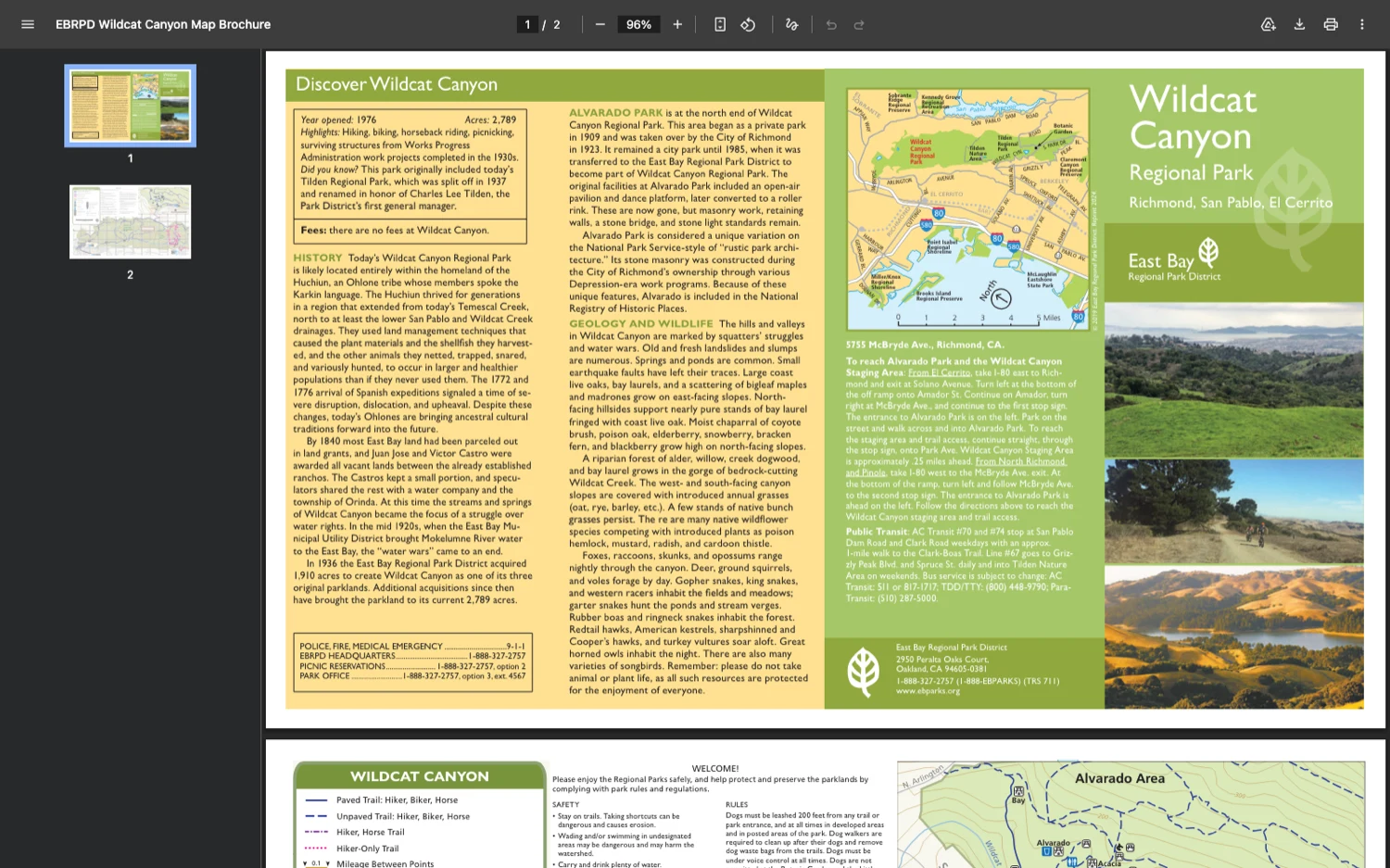
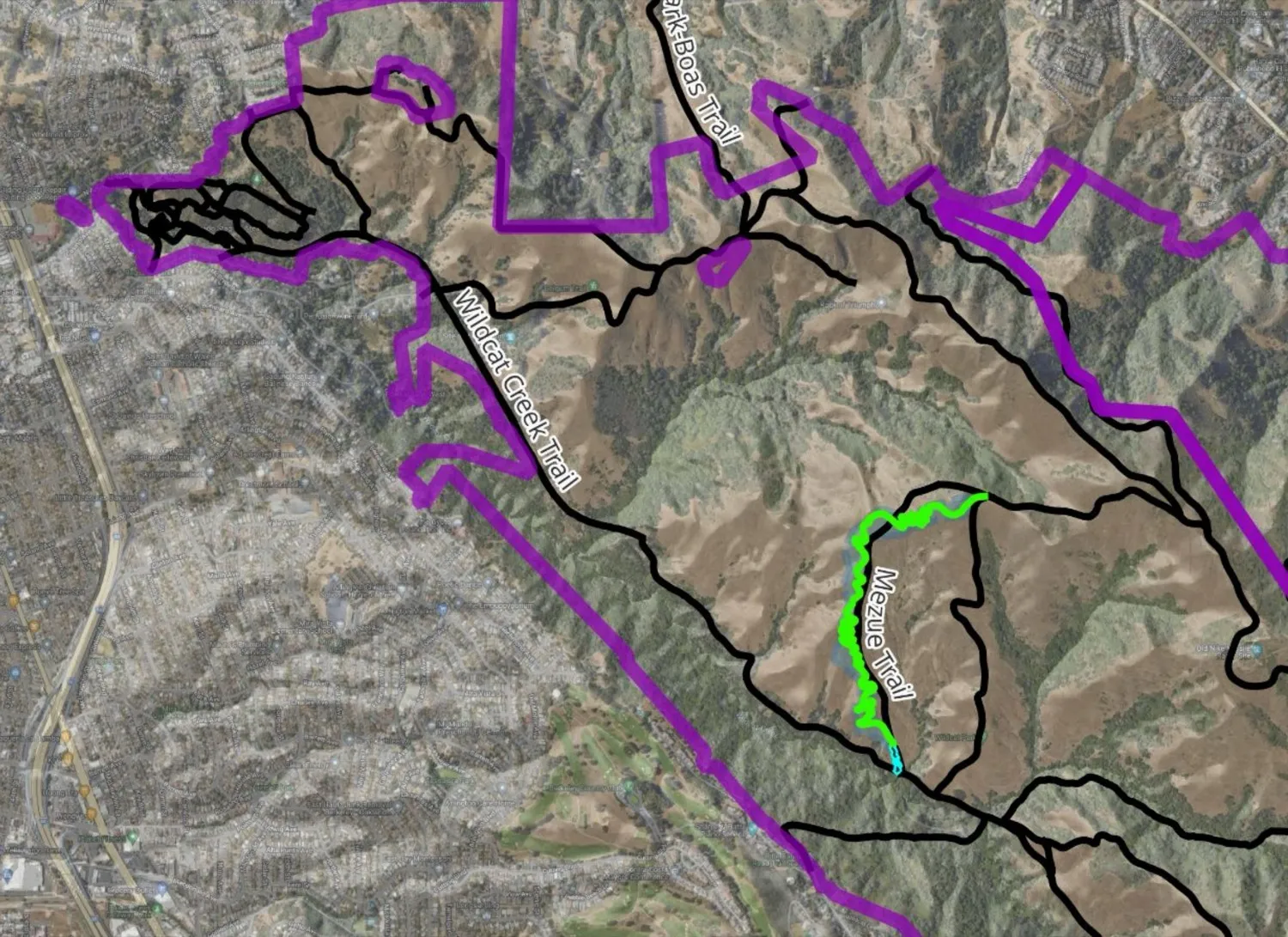
Proposed alignment (green) — EBRPD project description (PDF)
Interactive map — explore the park and surrounding area
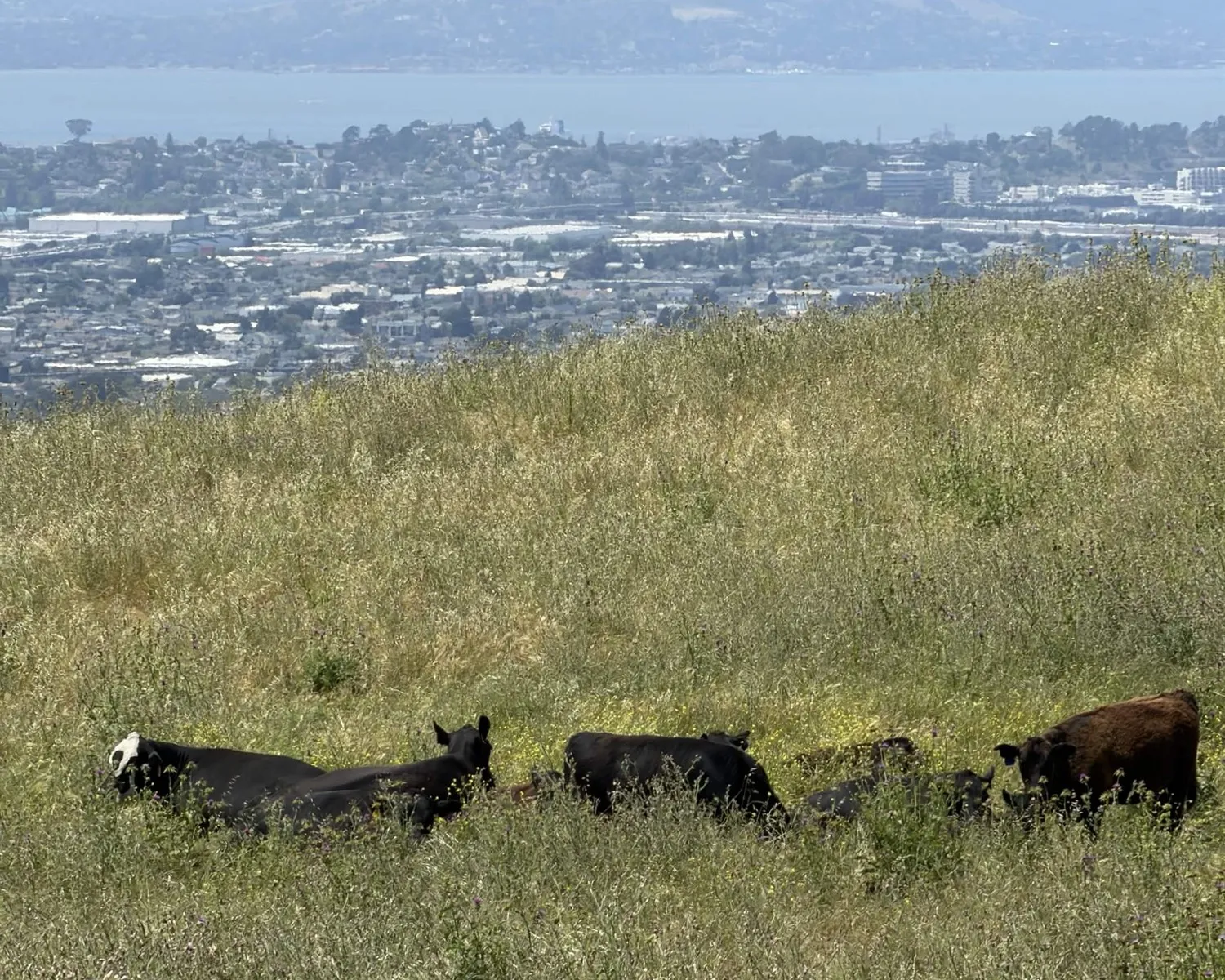
The trail corridor today — cattle grazing on open grassland above Richmond. Not the undisturbed wilderness opponents describe. See more photos of the site today →
What's on the Trail?
Designed by Pointe Strategies, a Colorado-based firm that specializes in sustainable, purpose-built mountain bike trail systems.
Rollers
Smooth, wave-like undulations that help manage speed naturally while keeping the ride fun and flowy.
Berms
Banked turns that let riders carry speed safely through corners — like a velodrome built into the hillside.
Jumps
Optional jump features with rollable alternatives, so every rider can choose their own adventure regardless of skill level.
Turnout Areas
Designated rest and passing zones built into the trail so faster riders can pass safely and everyone can catch their breath.
Directional Design
One-way, downhill-only traffic eliminates head-on conflicts and creates a predictable, safe riding experience for everyone.
Separated Use
A dedicated bike-only corridor keeps hikers and equestrians on their own trails. EBRPD is also proposing to close nearby Leonards Trail to bikes — hikers gain, not lose.
A local 5-year-old and her dog riding Wildcat Canyon. Kids (and pups) like these are why this trail matters.
Pointe Strategies
The Park District commissioned a design study by a third party, Pointe Strategies, to identify a proposed alignment within the study corridor and explore features typically seen on bike trails throughout the nation. The study explored the use of prefabricated features made of wood and metal framing commonly used in trail design as an alternative to sculpted dirt features to reduce soil erosion and reduce maintenance burden. The Park District will analyze the environmental impacts of both prefabricated and dirt trail features during the CEQA process.
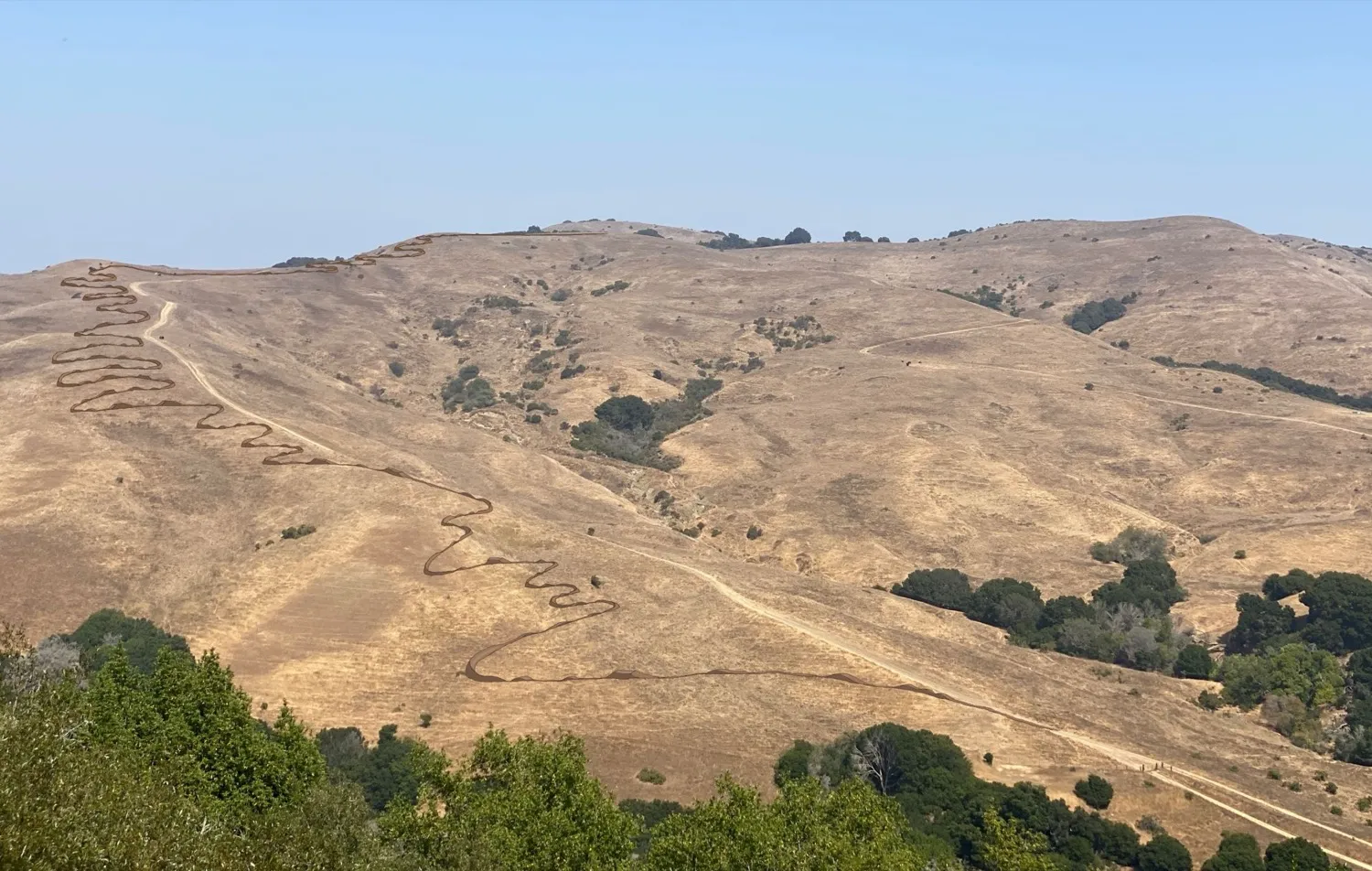
Conceptual rendering — a narrow trail of switchbacks on existing grazing land, alongside the Mezue service road. Source: Pointe Strategies / EBRPD
Project Milestones
From master plan to environmental review — 22 milestones over a decade of community effort. Here's where things stand.
EBRPD Master Plan
EBRPD issues a Master Plan stating the District will add single- and multi-use narrow trails for bike riders, hikers, equestrians, and people with dogs. Only 13 miles of trail had been added over the prior 30 years despite increasing parkland by 46%.
Staff Study Reveals Trail Gap
At a meeting, staff present data showing no new narrow trail has been added in Tilden and Wildcat Canyon Parks for decades — despite hundreds of riders from local NICA teams now practicing there up to 2 hours/day, multiple times per week, for 6 months a year.
Initial Proposal
NorCal NICA and BTCEB formally propose to EBRPD that a flow trail be built near Leonard's Trail in Wildcat Canyon Park to serve high school cycling teams and the broader community.
Site Assessment & Relocation
EBRPD staff conduct site visits and assessments. The proposed site is moved from Leonard's Trail to Mezue Trail to avoid environmentally sensitive species.
Video: Site move history (1:51)Public Board Session
NICA Coach Barb Smith makes public comment supporting the flow trail, offers financial support for construction and volunteer commitments for maintenance. Over 2,000 petition signatures presented to the EBRPD Board of Directors.
Video: Public comment (min 4:30)Site Field Visit
Director Echols, Director Rosario, and Assistant General Manager Kristina Kelchner tour the proposed corridor to evaluate the site in person.
Trail Users Group Discussion
Wildcat Flow Trail is briefly discussed in the Trail Users Group Zoom chat. Historical opponents of mountain bikes are involved in the discussion.
Park Advisory Committee Presentation
EBRPD staff present a description of the Wildcat Flow Trail to the Park Advisory Committee. Project enters the formal public planning process.
Biological Assessment Completed
External consultant Nomad Ecology issues report concluding the trail poses no significant impacts to wildlife or plants, provided precautions are taken during construction.
Opposition Letter Sent
Historical opponent of improving mountain bike access sends letter to the Board opposing the Wildcat Flow Trail.
Trails Study Session
EBRPD Trails Development director Sean Dougan provides overview at Board Trails Study Session. States no show-stoppers found. Three directors speak in support of further study; no directors object.
Video: Board session (53:30 - 1:10)Pointe Strategies Hired
EBRPD hires Pointe Strategies to do a preliminary design of the flow trail.
Sierra Club Opposition
Norman LaForce sends letter from Sierra Club opposing the trail. Reasons outlined in accompanying letter from Greenfire Law, PC. A group of advocates counter those arguments in an email to the Board.
First Public Meeting
EBRPD hosts first public meeting on the Wildcat Trail project — 285 community members attend, including opponents. Extensively advertised through normal EBRPD channels weeks in advance.
Board Briefing — Conceptual Plan
Staff present the conceptual plan developed by Pointe Strategies at Board meeting. Staff also present evaluation of alternative sites proposed by opponents — all three have show-stoppers.
Video: Board presentation (1:42)Preliminary Design Completed
Pointe Strategies delivers the preliminary trail design including alignment, feature placement, and environmental considerations. Final report issued to the public.
Budget Line Item Approved
Board approves 2025 EBRPD budget with Wildcat Flow Trail appearing as a line item for $300,000.
Board Approves EIR
The EBRPD Board votes 5-2 to proceed with a full Environmental Impact Report (EIR) under CEQA — a major milestone. Board later approves contract with Ascent Environmental for EIR, and the 2026 budget containing EIR funding.
Video: Board session (0:37)East Richmond Heights MAC Presentation
Project presented to the East Richmond Heights Municipal Advisory Council — the local neighborhood advisory body.
EIR Contract Authorized
Board meeting authorizes awarding the EIR contract to Ascent Environmental.
El Sobrante MAC Presentation
Project presented to the El Sobrante Municipal Advisory Council.
Notice of Preparation Issued
EBRPD issues the Notice of Preparation (NOP) for the EIR, officially kicking off the formal environmental review process and public comment period.
Public Scoping Meetings
EBRPD holds public scoping meetings to gather input on what should be covered in the EIR. Meetings extensively advertised weeks in advance. In March, EBRPD adds FAQ to the Wildcat Bike Trail website.
CompletedDraft EIR Completion
The Draft EIR is targeted for completion, which will include a full public comment period. Detailed environmental analysis will be available for review.
In ProgressConstruction (If Approved)
If the EIR is certified and the project receives final Board approval, construction could begin. The trail would be built to the specifications in the approved design.
The Briones Pilot Project — Proof It Works
EBRPD has already proven that dedicated bike trails and environmental stewardship go hand in hand — right here in the East Bay.
In April 2023, EBRPD launched a 20-month pilot project at Briones Regional Park to test dedicated trail management strategies — including bike-only directional trails, separated use by user type, and habitat restoration. The pilot ran through December 2024.
The Results
- 5.75 miles of trails formalized for bike access — the EBRPD Board of Directors voted to make the pilot permanent
- First bike-only directional trails in EBRPD history — proving the model that Wildcat would follow
- 5 miles of unsustainable "bootleg" trails closed and restored — illegally built trails were removed and habitat was restored
- 1.28 miles of new pedestrian-only trails added — hikers gained dedicated trails too
- Odd/even weekend system reduced conflicts — bikes on odd-numbered days, horses on even days, hikers welcome every day
- 4,700+ volunteer hours from 400+ community members since 2023 — the Stewards of Briones organize regular Dig Days where kids, parents, and neighbors build and maintain trails alongside EBRPD staff
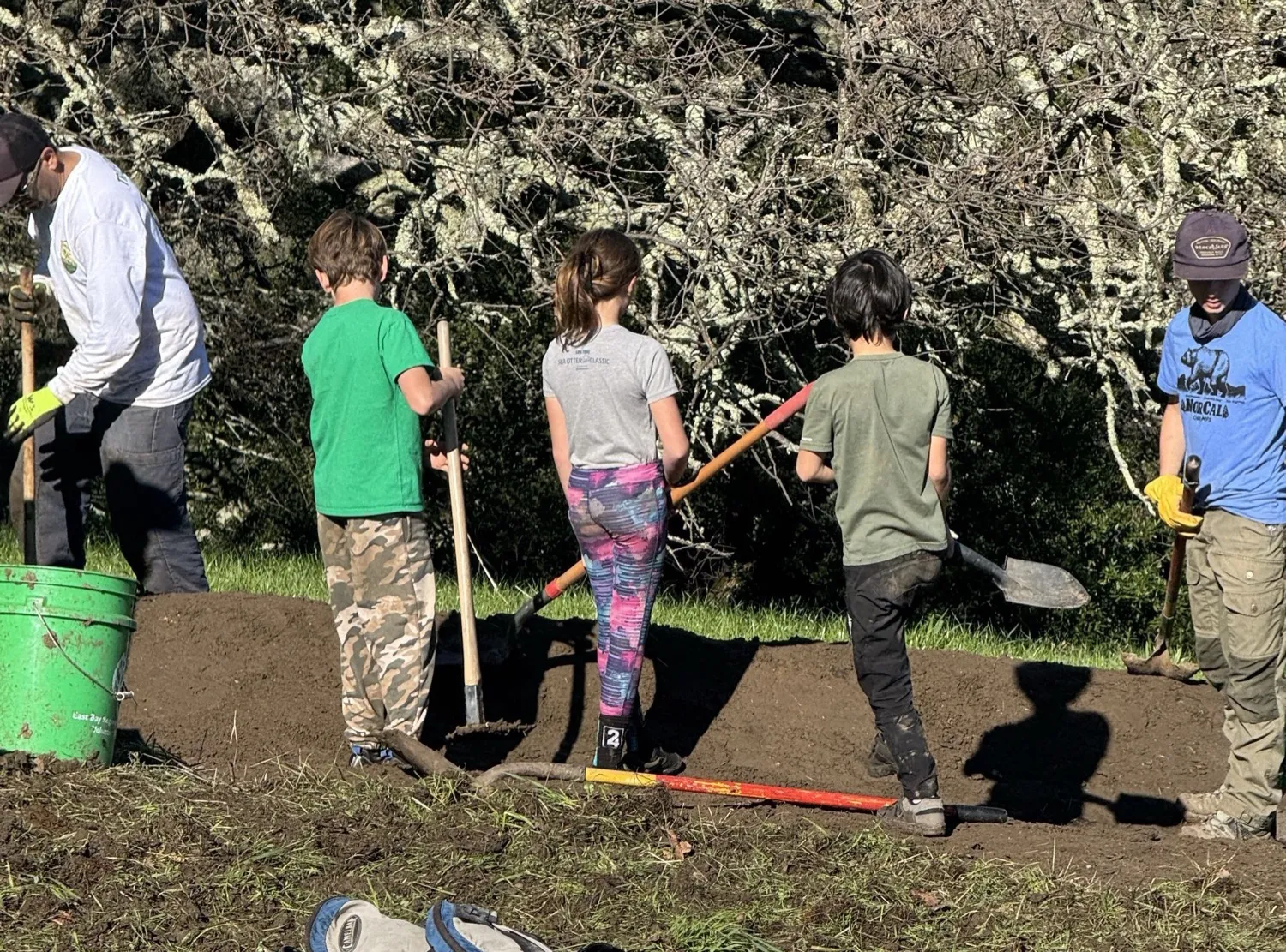
Community volunteers at a Briones Dig Day — kids and families building and maintaining trails together
Why This Matters for Wildcat
The permanent designation was challenged in court. On July 31, 2026, an Alameda County Superior Court judge denied that petition in its entirety (SPRAWLDEF v. East Bay Regional Park District, No. 25CV107760), leaving the Briones trails in place. The Briones Pilot demonstrates that EBRPD can successfully build and manage dedicated bike trails while improving environmental outcomes. The same organization (BTCEB) that helped make Briones a success is behind the Wildcat Flow Trail. The same park district that approved Briones is reviewing Wildcat.
Briones proved that purpose-built bike trails don't just coexist with nature — they replace unsanctioned bootleg trails and actually restore habitat. That's exactly the model for Wildcat Canyon.
Learn more about the Briones Special Management Area on EBRPD's website →
Crockett Hills — Multi-Use Done Right
While Briones demonstrates bike-only separation, Crockett Hills Regional Park shows that managed multi-use trails can also work — when done intentionally.
- 10 miles of bike-legal singletrack — the most in any single EBRPD park
- Equal hiker and mountain biker use by number — with minimal conflict
- No rogue trails, no need for restoration — proper access from the start eliminated the bootleg trail problem
- 500+ volunteer stewardship hours per year for over a decade — community investment, not just recreation
- Golden Eagles nest annually — conservation and trail access coexist
- Hikers who prefer bike-free routes have other trail and road options — choice, not conflict
Different parks call for different approaches. Bike-only separation (Briones, Wildcat) and managed multi-use (Crockett Hills) are both proven models within the same park district. The common thread: intentional trail management reduces conflict, builds community stewardship, and protects the environment.
The CEQA Process
The Wildcat Flow Trail is going through a full Environmental Impact Report (EIR) study under the California Environmental Quality Act (CEQA) — the most rigorous environmental review process in California. The project's potential impacts will be thoroughly studied, publicly debated, and addressed before any construction can begin.
What the EIR Will Study
The Environmental Impact Report will analyze potential impacts in areas including:
- Biological resources (wildlife, vegetation, sensitive species)
- Hydrology and water quality
- Soil erosion and geologic stability
- Recreation and public access impacts
- Noise, traffic, and construction impacts
- Visual and aesthetic resources
- Tribal and cultural resources
Public Participation
The CEQA process is designed to be transparent and participatory. Key public opportunities include:
- Scoping comments — Completed January 2026
- Draft EIR public comment period — Coming late 2026
- Final EIR responses — Every substantive comment will receive a written response
- Board hearings — Public testimony before any final decision
Biological Resources Assessment
As part of the environmental review, EBRPD commissioned a professional Biological Resources Assessment from Nomad Ecology, an ecological consulting firm based in Martinez, CA. Nomad Ecology conducted field surveys across the study area in both 2022 and 2024, evaluating habitat suitability for special status plants and wildlife, sensitive natural communities, and wildlife movement corridors.
Their findings: no special status plant species were detected in the study area, and every impact category was assessed as "less than significant" with the implementation of 10 standard mitigation measures — including wildlife-friendly fencing, pre-construction clearance surveys, nesting bird protections, and biological monitoring.
Read the full 186-page Biological Resources Assessment →
This process ensures that the trail, if built, will meet rigorous environmental standards. The project's supporters welcome this thorough review because they're confident the trail can be built responsibly.
For official CEQA documents, visit the EBRPD Wildcat Canyon page.